
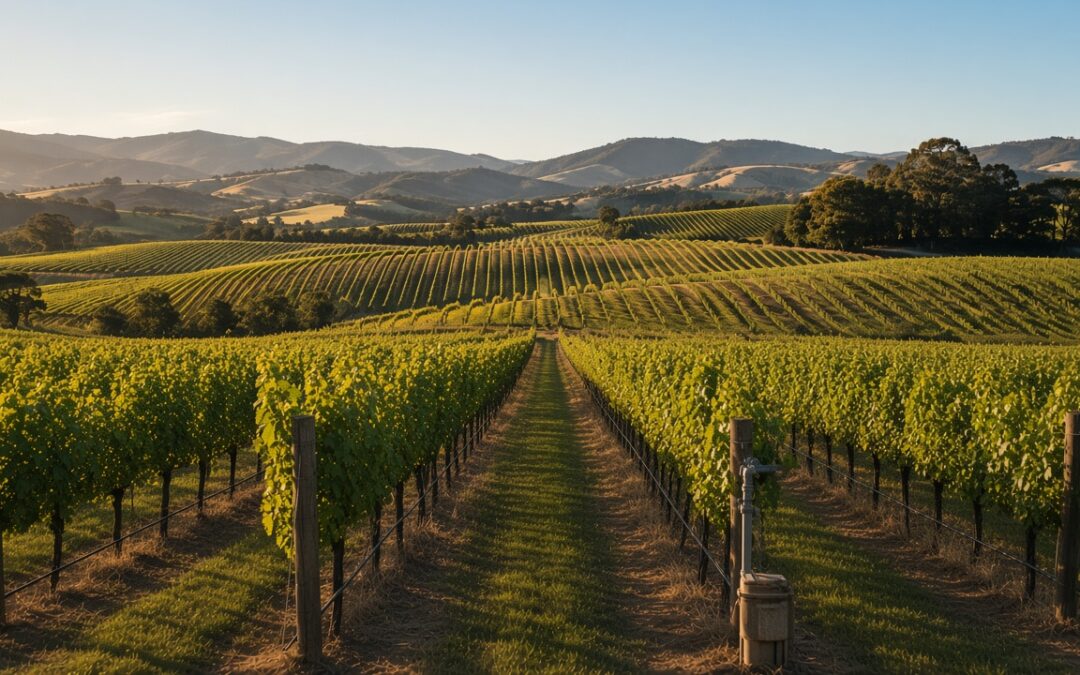
Short answer: California vineyard irrigation is easier to get right block by block. Each block gets its own water budget from local ET (evapotranspiration) data, a crop coefficient that fits its canopy, and a deficit target that fits the wine you want. Then soil tension or soil moisture readings in that block confirm when to start and how long to run. Monitoring tells you what each block needs. Control lets you act on it without driving the ranch.
A lot of California vineyards still run on one calendar: every block gets the same hours on the same days, and someone drives out to open and close valves. That is simple, and it is usually wrong somewhere. The hillside Cabernet block on shallow soil is stressed by midsummer while the bottomland Chardonnay next door is still pulling water from deep in the profile. On a coastal ranch you may be holding water back. In the San Joaquin Valley, growers typically start irrigating sooner.
This guide covers what changes from block to block in California, how UC Cooperative Extension suggests turning that into a water budget, and how to monitor and control each block so the plan actually happens in the field. If you want the general case for splitting a vineyard into blocks, start with our earlier post on vineyard irrigation scheduling by block. This one is about doing it in California, with California data.
What Changes From Block to Block in a California Vineyard
Climate zone. California wine grapes grow from the foggy coast to the hot interior valleys, and water demand follows. UC Davis viticulture researcher Larry Williams notes he generally starts irrigating San Joaquin Valley vineyards when midday leaf water potential drops to about -10 bars, and coastal vineyards at about -12 bars or slightly lower. Same crop, different trigger, because the climate and the goals are different.
Soil and rooting depth. Williams also points out that when irrigation should start each year depends on how much water is stored in the soil profile, which is a function of rainfall, soil type and rooting depth. Two blocks on one property can need their first irrigation at different times.
Canopy and trellis. Vine water use scales with how much ground the canopy shades. UC Cooperative Extension’s Central Sierra workshop materials estimate the crop coefficient (Kc) as the percent of the vineyard floor shaded by the canopy times 0.017. A block shading 40% of the floor works out to a Kc of 0.68. A young or low-vigor block shades less and needs less.
Variety and wine goal. Many red wine programs use deliberate water stress. UC guidance on regulated deficit irrigation (RDI) describes applying a set fraction of full vine water use, with common winegrape values from 35% to 65%, and timing the deficit around fruit set and veraison. A white block and a red block on the same ranch rarely share a target.
System performance. A block with clogged emitters or low pressure doesn’t deliver the water the schedule says it does. UCCE Sonoma’s irrigation guidance has growers measure emission uniformity (the average flow of the 25% of emitters with the lowest output, divided by the average flow of all sampled emitters) and adjust run times for it.
Put those together and “run everything 8 hours on Tuesday” leaves some blocks overwatered, some short and the record of what actually happened unclear.
How UC Extension Builds a Water Budget for Each Block
UC Cooperative Extension guidance for wine grapes, from UCCE Sonoma to the Central Sierra workshop materials, uses the same basic math:
- Get reference ET (ETo) for your area from CIMIS, the California Irrigation Management Information System, or from UC IPM weather data. ETo is the water used by well-watered grass, and it changes daily with heat, humidity, sun and wind.
- Multiply by the block’s crop coefficient (Kc) to get full vine water use (ETc). Kc rises as the canopy fills in, so it is a block-level number, not a ranch-level one.
- Apply your deficit target. For an RDI program, multiply ETc by the fraction you want to apply. The Central Sierra materials show set-through-veraison targets stepping from 60% down to 35%, depending on variety, winery and brand.
- Account for soil water and rain. Stored soil moisture and in-season rainfall cover part of the need, especially early.
- Convert to hours. Divide by your system’s real application rate and adjust for emission uniformity. UCCE Sonoma notes that a well-maintained drip system can approach 92% efficiency, so a 1-inch net need takes about 1.09 inches applied.
UCCE Sonoma even publishes an Excel irrigation scheduling worksheet that does this math with historical ETo, which you then update with current CIMIS data.
Here is how two blocks on one ranch can come out:
| Block A: hillside red | Block B: valley-floor white | |
|---|---|---|
| Soil | Shallow, gravelly | Deeper loam |
| Canopy shading | Smaller canopy | Fuller canopy |
| Water goal | Moderate deficit for fruit character | Closer to full ET |
| Likely start | Earlier, soil profile empties sooner | Later, more stored water |
| Run time | Shorter sets, more often | Longer sets, less often |
The point isn’t the exact numbers. It’s that the budget makes sense one block at a time.
Why the Budget Alone Isn’t Enough: Measure Each Block
An ET budget is an estimate. It assumes your Kc is right, your emitters are delivering what they should and the soil holds what you think it holds. UC and Resource Conservation District guidance pairs the budget with field checks: shoot tip observations, pressure chamber readings of vine water status, and soil moisture sensors.
The Sonoma Resource Conservation District’s grower toolkit notes that soil moisture probes help growers decide when to start irrigating or hold off, that they’re more effective where soil is more uniform, and that data loggers make them more useful, with some systems streaming data wirelessly to a computer or smartphone. That last part matters in California, where blocks are often spread across hillsides and separate ranches.
For block-level monitoring, a practical setup looks like this:
- One monitoring point per management block, placed in vines that represent the block, not the wet spot by the riser. Our guide to soil moisture sensor placement covers depth and location.
- More than one depth, so you see whether water reached the active roots or stopped short, and whether a long set pushed water below them.
- Soil tension, not just a percentage, if you want a reading that tracks how hard the vine has to work to pull water. See soil tension irrigation scheduling.
- Pressure on the line, so a block that “ran” but delivered low pressure shows up the same day. Our low irrigation pressure checklist walks through the usual causes.
Keep using the pressure chamber if you already do. Soil readings tell you what is happening between the walks.
From Monitoring to Control: Acting on Each Block
Knowing that Block A needs water today and Block B can wait three days helps when someone can make that happen. On many California ranches that means a drive across the property, sometimes twice a day, to open and close valves at the right time.
Block-level control closes that gap:
- Remote valve control lets you start and stop each block’s valve from a phone or computer, so a two-hour pulse on the hillside block doesn’t require a two-hour round trip. Our post on remote irrigation valve control covers the basics.
- Automation based on soil tension targets can start and stop a block’s irrigation at the targets you set for that block, so each one follows its own target instead of the ranch calendar.
- Pump timing matters too. If your pumps are on a time-of-use electric rate, shifting long sets off peak can lower the pumping bill. See our explainer on ag electric rates for irrigation pumps.
The Groundwater Angle: Why Block Records Matter More Now
California’s Sustainable Groundwater Management Act (SGMA), passed in 2014, requires local groundwater sustainability agencies in high and medium priority basins to develop plans that avoid undesirable results and address overdraft within 20 years, according to the California Department of Water Resources. Rules differ by basin, so check with your local agency. Either way, a vineyard that knows what each block received, and why, is in a better position to put every acre-foot where it does the most good. If your blocks run from wells, pairing block data with remote well monitoring shows how the source is holding up through the season.
A Simple Way to Start
- List your management blocks by soil, variety, age and wine goal. If two blocks always get the same decision, they can share a monitoring point for now.
- Pick two blocks that behave differently, such as a hillside block and a valley-floor block, and monitor both through one season.
- Build a CIMIS-based budget for each using UCCE’s math or worksheet.
- Compare the budget with the soil readings each week and adjust Kc, deficit targets and run times.
- Add remote control where the drive costs the most, usually the farthest or most often irrigated blocks.
How AgriLynk Helps
AgriLynk is a vineyard irrigation monitoring and control system designed and assembled in Murrieta, California. Field stations bring soil tension readings from multiple depths (three depths standard in starter packages) in each block into one dashboard you can open in any browser on your phone, tablet or computer. Field stations report every 8 minutes. One field station controls one valve, so each block you want to control gets its own station. The Control package adds manual remote open/close and timer scheduling, and Autonomous can start and stop irrigation based on the soil tension targets you set for each block. Most irrigation solenoids are supported; tell us what you have and we’ll confirm. Alerts can go to the right people, and you get an alert if a station stops reporting.
Field stations run on solar and battery and don’t need Wi-Fi. Remote blocks with compatible cellular coverage can connect through cellular field stations with no gateway, and clustered blocks can share a gateway that connects over your Wi-Fi or by cellular. Start with one or two blocks and expand. See pricing or tell us about your blocks, or call (760) 723-1529.
Frequently Asked Questions
How often should a California vineyard be irrigated?
It depends on the block. UC Cooperative Extension guidance bases the amount on local ET from CIMIS times a crop coefficient for the block’s canopy, adjusted for your deficit target, stored soil water and system efficiency. Soil tension or soil moisture readings and vine water status readings confirm the timing.
Do coastal and Central Valley vineyards irrigate differently?
Yes. UC Davis viticulture researcher Larry Williams generally starts irrigation in San Joaquin Valley vineyards at about -10 bars midday leaf water potential and in coastal vineyards at about -12 bars or slightly lower, reflecting different climates and production goals.
What is regulated deficit irrigation in wine grapes?
RDI means applying a planned fraction of full vine water use during set periods, often around fruit set and veraison. UCCE Sonoma lists common winegrape values from 35% to 65% of full vine water use (ETc).
How many soil moisture monitoring points does a vineyard need?
Start with one per management block that gets its own irrigation decision, in representative vines, at more than one depth. Blocks that always get the same decision can share a point at first.
Can I control vineyard irrigation valves remotely?
Yes. Remote valve control lets you open and close each block’s valve from a phone or computer. With AgriLynk, the Control package adds manual remote open/close and timer scheduling, and Autonomous can start and stop irrigation based on the soil tension targets you set. One field station controls one valve, and most solenoids are supported; tell us what you have and we’ll confirm.
Sources
- UC Cooperative Extension Sonoma County: Determining Irrigation Requirements
- UC Cooperative Extension Sonoma County: Excel Irrigation Scheduling Worksheet
- Larry E. Williams, UC Davis and Kearney Agricultural Research and Extension Center: Deficit irrigation of wine grape vineyards
- UC Cooperative Extension Central Sierra: The basics of irrigation scheduling using ET data from CIMIS (Inches to Hours workshop)
- Prichard and Smith, UC Cooperative Extension: Regulated Deficit Irrigation Management for Winegrapes
- Sonoma Resource Conservation District: Irrigation and Scheduling Toolkit for Grapegrowers
- California Irrigation Management Information System (CIMIS)
- California Department of Water Resources: Sustainable Groundwater Management Act