
One field station. No gateway required.
AgriLynk cellular field stations connect directly to the cloud, making remote monitoring and supported control practical for one field, well, tank, valve, or other critical location.
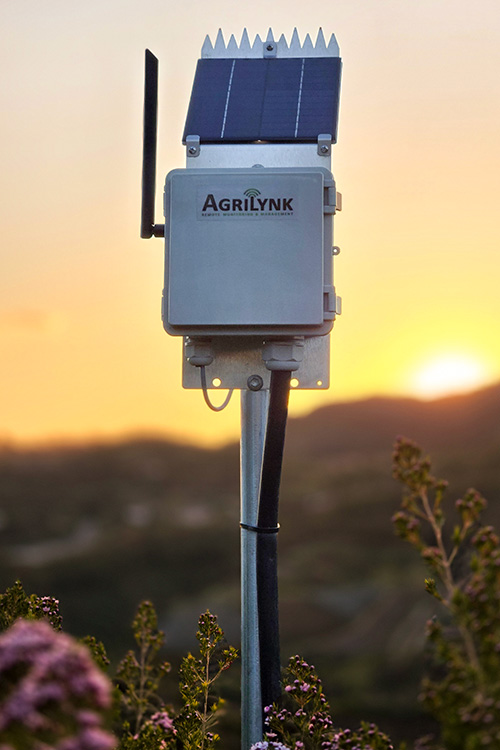
Standalone agricultural monitoring, without unnecessary infrastructure.
An AgriLynk cellular field station communicates directly with the AgriLynk cloud through compatible cellular service. It keeps AgriLynk’s solar-powered field design while removing the need for a separate gateway in smaller or isolated installations.
No separate gateway
Deploy a cellular-enabled station without purchasing, powering, and installing a second communication device.
No field Wi-Fi
The station uses compatible cellular service to communicate with the cloud instead of relying on local Wi-Fi.
Solar-powered operation
The field station remains designed for standalone solar and battery operation at remote locations.
Start at one priority location
Begin with the well, tank, field, valve, or monitoring point that matters most today.
Expand when it makes sense
Add independent cellular stations or build a shared gateway network as your operation grows.
One familiar platform
View field data, alerts, history, and supported controls through the AgriLynk platform.
Connect the field directly to the AgriLynk cloud.
The hardware changes how the station communicates—not the practical AgriLynk experience your team uses.
Connect the field
Supported sensors, valves, pumps, and other equipment connect to the AgriLynk field station.
Send data directly
The cellular-enabled station communicates with the AgriLynk cloud without a separate gateway.
Manage remotely
View current and historical data, receive alerts, and use supported controls through the AgriLynk platform.
Cellular field station or shared gateway?
Neither option is inherently better. AgriLynk recommends the connectivity model that fits your number of stations, farm layout, cellular coverage, existing infrastructure, and expected expansion.
| Consideration | Standalone Cellular | Shared Gateway Network |
|---|---|---|
| Typical application | One or a few stations; isolated or widely separated locations | Multiple stations concentrated on one farm |
| Separate gateway required | No | Yes |
| Field station power | Solar and battery | Solar and battery |
| Internet connection | The field station connects directly through compatible cellular service | The gateway provides the internet connection for multiple stations |
| Expansion | Add independent cellular-enabled stations | Add stations to the shared farm network |
| Primary advantage | Simple, low-infrastructure deployment | Efficient scaling across larger multi-station farms |
Useful for small starts—and isolated assets on large farms.
Cellular connectivity is not only for small farms. A large operation may use it for a remote well, tank, field, or separate property outside its primary AgriLynk gateway network.
Common standalone applications
- One-field monitoring
- Remote wells
- Stock tanks
- Reservoirs
- Isolated irrigation valves
- Separate properties
- Pilot installations
- Remote farm assets
Farms that benefit
- Small farms
- Specialty crop growers
- Vineyards
- Orchards
- Nurseries
- Livestock operations
- Multi-property farms
- Large farms with isolated locations
Cellular field station FAQ.
Does every AgriLynk field station require a gateway?
No. Cellular-enabled AgriLynk field stations can connect directly to the cloud without a separate gateway. AgriLynk also supports shared gateway networks for larger multi-station installations.
When should I use a cellular field station?
Cellular is generally well suited for one or a few stations, remote assets, isolated fields, separate properties, and locations where installing a gateway adds unnecessary infrastructure.
When should I use an AgriLynk gateway?
A shared gateway is generally a good fit when multiple field stations are concentrated on the same farm or an operation expects to expand to many nearby stations.
Can a small farm use AgriLynk?
Yes. Cellular connectivity allows a farm to start with a single AgriLynk field station without purchasing and powering a separate gateway.
Can a large farm use cellular stations?
Yes. Cellular can be useful for an isolated well, field, tank, or property even when the main operation uses a shared AgriLynk gateway network.
Does a cellular field station require Wi-Fi?
No. A cellular-enabled field station communicates through compatible cellular service rather than relying on local Wi-Fi.
Is the field station still solar powered?
Yes. The cellular option retains AgriLynk’s standalone solar-powered field operation.
Can I start with one station and expand later?
Yes. AgriLynk is modular. You can start at one critical location and add cellular stations or a shared gateway network as your needs grow.
Tell us what you need to monitor or control.
We will recommend the connectivity model that fits your locations, layout, coverage, and plans for expansion.