
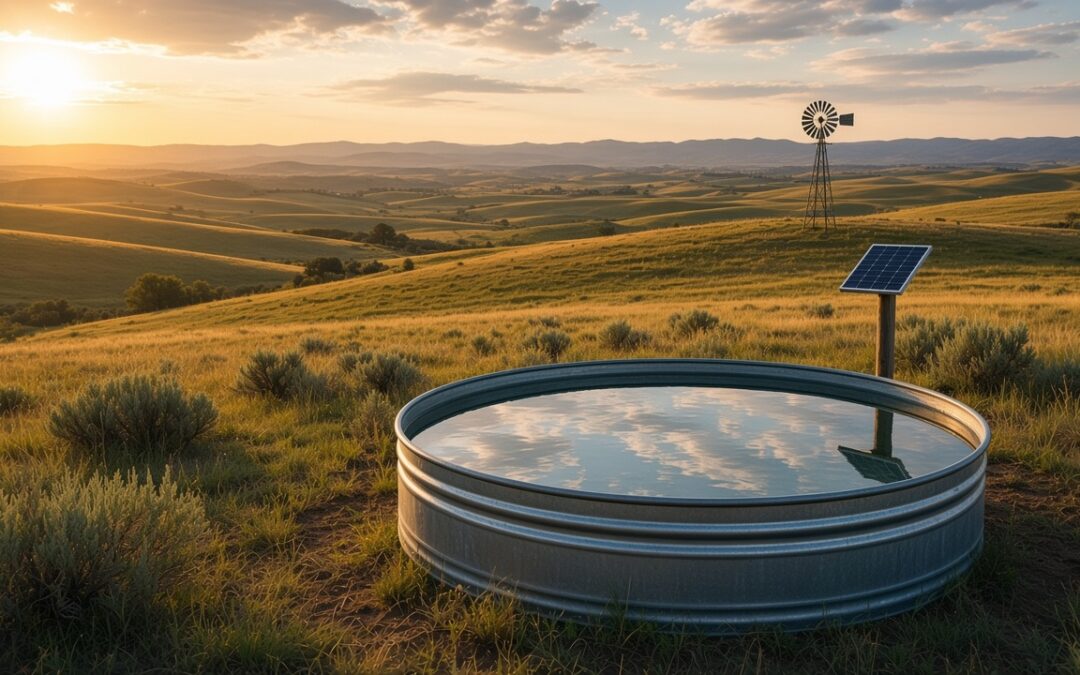
The picture came in at 7 a.m. like it does every morning: the tank, the fence, a little sky in the water. Looks fine. By 4 p.m. the cattle are standing around a dry rim, because the float stuck shut around 9 and nobody was going to look again until tomorrow’s photo.
That is the honest gap between a water trough camera and a stock tank level sensor. Both save you a drive, but they answer different questions. A camera answers “what did the tank look like at that moment?” A level sensor answers “how much water is in it, and which way is it moving?”
For the bigger story on why tanks fail between checks, see our post on why stock tanks dry up unnoticed. This one is the buyer’s comparison.
Quick Takeaways
- A camera gives you a look. A sensor gives you a number. South Dakota State University (SDSU) Extension lists visual confirmation as a trail camera’s biggest strength and “no metrics” as its main weakness. Its biggest knock on tank monitors is the reverse: no picture.
- A photo is a moment. A measured trend shows a tank falling between pictures.
- Both need a signal, and photos use far more data than readings.
- Winter fools both. Ice can hold a float open or cap a full tank.
- For the tanks that hurt most when they fail, many operations end up with both.
How much water is riding on that tank?
North Dakota State University Extension estimates a 900-pound lactating beef cow at 17.9 gallons per day at 80°F, and a 1,600-pound mature bull at 20.6 gallons per day at 90°F. NDSU notes that temperature and humidity drive intake most, and that limiting water intake reduces feed consumption and animal performance.
Fifty cows at 17.9 gallons is close to 900 gallons a day before you count calves. On a hot afternoon, a once-a-day photo of a tank under that kind of draw is a snapshot of a moving target.
What a water trough camera actually tells you
A cellular trail camera pointed at the tank sends pictures to your phone on a schedule or when it senses motion. Nebraska Extension’s BeefWatch calls it one of the most basic and affordable options.
What it does well:
- Shows what a number cannot: ice, a tipped or damaged tank, algae, a dead animal in the water, a gate left open.
- Cheap to try. SDSU puts cellular trail cameras at as little as $50 to several hundred dollars. Nebraska Extension listed $150 to $750 per camera in 2020, plus a monthly data or service fee.
- Easy to move with the cattle from pasture to pasture.
Where it falls short:
- It is a moment, not a trend. Nebraska Extension describes judging the level “based on a series of pictures taken.” If the float fails an hour after the morning shot, you find out at the next one.
- Level is hard to read in a photo. Sky reflections, midday glare, low sun, a dirty lens, and night shots make “is it full?” a judgment call. A tank a few inches down can look full from a fence post.
- Field of view is the limit. Nebraska Extension lists that as a camera’s main con. A broken line or a dead pump up the hill is not in the frame.
- Photos cost data. Some camera plans include only a limited number of pictures per month, and one service Nebraska Extension reviewed charges by data use and images per month.
- Someone has to look. A picture does not raise its hand.
What a stock tank level sensor actually tells you
A livestock water sensor for tank level measures depth. Nebraska Extension describes dedicated systems as a base station with an antenna and battery, plus a sensor on a cable placed in the tank. Its 2020 article also points to ultrasonic sensors that measure from above at set times.
What it does well:
- A number on a schedule. One system Nebraska Extension reviewed reports up to 24 readings a day on cellular, or 4 on satellite.
- Direction, not just level. A tank that drops all day and never recovers is a fill problem. A sudden overnight drop looks like a leak or a tipped tank. SDSU lists “collects metrics for water disappearance” as a key strength.
- Alerts without anyone looking, at a low-level threshold that leaves enough reserve to get there in time.
Where it falls short:
- No picture. SDSU calls that the biggest drawback of tank monitors.
- Depth is not access. A tank can read full under a sheet of ice.
- Higher start-up cost. SDSU puts commercial systems at $500 and up, and Nebraska Extension notes they often need a monthly or annual subscription and are harder to move than a camera.
Either way, SDSU’s advice holds: mount units where cattle cannot rub or scratch them.
Side by side
| Question | Water trough camera | Stock tank level sensor |
|---|---|---|
| What you get | Photos at set times or on motion | Measured depth on a schedule |
| Catches a slow fill failure between checks | Only if a photo lands at the right time | Yes, the trend shows it |
| Alerts without anyone looking | Usually no | Yes, at your threshold |
| Shows ice, damage, algae, a dead animal | Yes, if in frame and the light is good | No |
| Night | Depends on the camera’s night mode | A reading is a reading |
| Data use | Grows with every photo | Small readings |
| Starting cost (extension estimates) | $50 to $750 per camera, plus data | $500 and up, plus subscription |
Winter is where both can fool you
Alberta Agriculture’s guide to automatic livestock waterers says low-energy waterers must be checked at least twice daily in cold weather: in the morning to make sure covers are not frozen shut, and at night to make sure floats are not held open by ice buildup, which forms as cattle dribble water after drinking. The Extension Foundation’s Farm Energy checklist adds the year-round version: keep float valves in good condition so they do not stick open or leak.
- Float stuck shut: a sensor shows a steady decline that never recovers. A camera catches it at the next photo.
- Float frozen open: depth may look normal while the tank overflows. A camera may show ice and a wet ring if the light is good.
- Surface frozen over: the sensor can read full. A daylight photo is better here.
On pipeline systems, Nebraska Extension notes a pressure sensor on the line can alert you when a well goes down, the power goes out, or a float comes off, which backs up what the tank reading tells you.
Power and signal
Remote tanks rarely have power, so both tools usually run on batteries with solar charging. Nebraska Extension notes solar panels can be added to remote cameras, and SDSU describes tank monitors as typically solar powered. Signal is the bigger question: cameras need “adequate cellular service to send photos,” and SDSU lists cellular connectivity as the first factor to weigh. Tank monitors come in cellular, satellite, and radio-network versions. Test the spot before you buy.
When a camera is worth adding, and when both make sense
Add a camera where you need to see, not just measure: ice-prone tanks, tanks that get tipped or fouled, short-term or rotational sites, and water points where you also want eyes on a gate. A fresh photo after a level alert can also tell you whether the trip needs a part, a trailer of water, or both.
For the water points that carry the most cattle or sit farthest from the house, the honest answer is often both: a sensor that watches the trend and alerts on its own, and a camera that shows what the number cannot. SDSU’s takeaway is that this technology depends on the user learning it and trusting that it monitors the water accurately. A measurement backed by a picture builds that trust fast.
Questions ranchers ask
Is a water trough camera enough to monitor stock tanks?
For a tank you check often, it can be. For a remote tank under heavy summer use, a camera only shows what the tank looked like when it took the picture. A level sensor adds a measured trend and alerts in between.
What is the difference between a livestock water sensor and a trail camera?
A sensor measures depth and can alert you when the level crosses a threshold. A camera sends a photo you have to open and judge.
Do stock tank level sensors work in winter?
They keep measuring depth, but depth does not prove cattle can drink. Ice can cap a full tank or hold a float open, so winter is when a camera or a regular check adds the most.
What is IoT livestock monitoring?
Field devices such as tank level sensors, pressure sensors, and cameras that send readings or images over cellular, satellite, or a private radio network to your phone or dashboard, so you can check water points without driving to each one.
How AgriLynk Helps
AgriLynk remote stock tank monitoring is the measurement side of this comparison. Track supported tank and water-point levels from a dashboard, get email or text alerts before a tank becomes an emergency, and use the history to decide which pasture needs a trip today. AgriLynk does not sell cameras, so if you want pictures too, a trail camera can sit right beside the tank.
An isolated tank can run on a solar-powered cellular field station with no farm gateway, where compatible cellular coverage exists. Several nearby water points can share one gateway on a private long-range network. See how it works and pricing, then show us your water points: how many tanks, how far apart, and what power and coverage look like. Or call (760) 723-1529.
If your tanks are fed by wells and pipelines spread across several sites, our remote farm water monitoring guide shows how to read the well, the tank and the line together.
Sources
- North Dakota State University Extension: Livestock Water Requirements (AS1763)
- South Dakota State University Extension: Water Monitoring Systems for Livestock
- University of Nebraska-Lincoln BeefWatch: Using technology to monitor water on the ranch (2024)
- University of Nebraska-Lincoln BeefWatch: Checking Water from Afar (2020)
- Alberta Agriculture: Automatic Livestock Waterers (Agdex 716 C52)
- Extension Foundation, Farm Energy: Livestock Watering Systems Energy Efficiency Checklist and Tips