
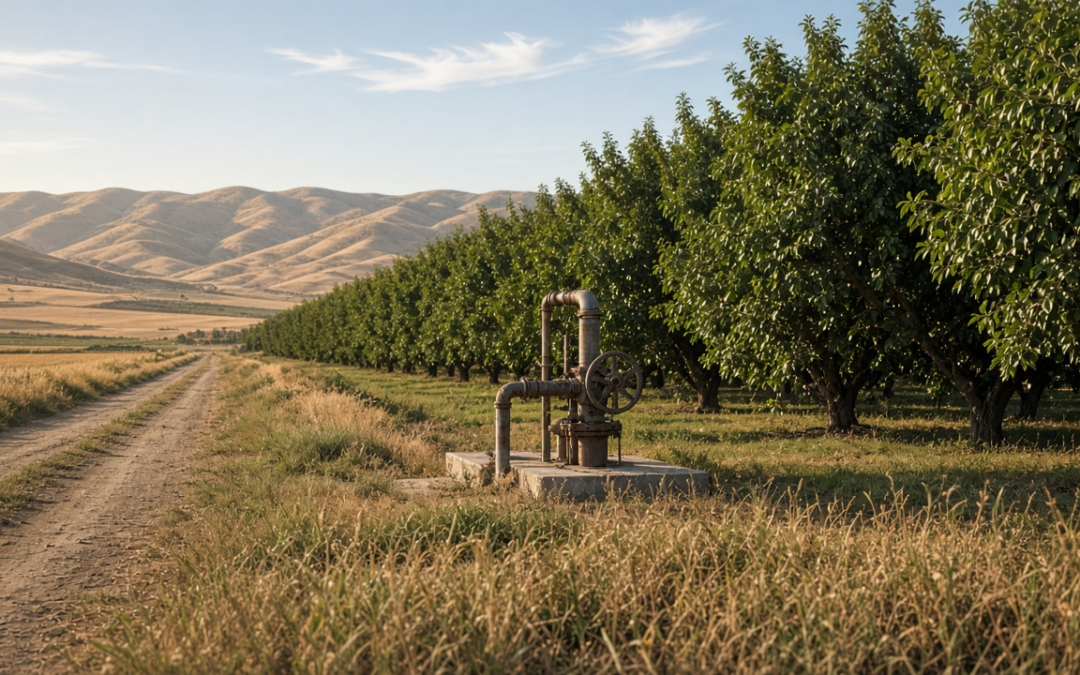
It is mid-August, the set has been running for days, and the discharge line starts to surge. Someone at the well hears it before anyone sees it on a gauge. By then the question is no longer “is there water down there?” It is “how much room did we have left, and when did we lose it?”
Every pumping well draws down. That part is normal. The trouble starts when the pumping level gets too close to the two things in the well that should never see air: the pump intake and the top of the well screen. This post is about that margin: where it is, why it shrinks, and how to set a low-water alert that warns you while you still have options.
If you are still sorting out why your level is dropping, start with Why Is My Well Water Level Dropping While the Pump Is Running? and Aquifer Drawdown or Pump Problem?. This one assumes you want to know how low is too low.
Quick Takeaways
- Drawdown is the distance between the static water level (pump off) and the pumping water level (pump on). NDSU Extension calls it the head needed to push water through the aquifer into the well.
- Your real limit is whichever comes first going down: the top of the screen or the pump intake. NDSU Extension says never let the pumping level drop below the top of the screen.
- The margin is smallest in late summer and shrinks over the years as screens plug. Neighbors pumping the same aquifer can shrink it further.
- Set your alert above the limit, not at it, and watch the drawdown trend so the alert is not your first warning.
The four depths that matter
Most growers know their static level and maybe their pumping level. To answer “how low can it go,” you need two more numbers that do not change from day to day.
| Depth | What it is | Where to find it |
|---|---|---|
| Static water level | Depth to water after the pump has been off long enough to recover | Measured at the well, pump off; note how long it has been off |
| Pumping water level | Depth to water while the pump runs at its normal rate | Measured at the well during a set, at a consistent point in the set |
| Top of screen | Where the slotted screen (the part that lets water in) begins below the solid casing | The driller’s well log or completion report |
| Pump intake | The depth where water enters the pump | Pump setting records from your pump installer (column pipe length plus pump and intake dimensions) |
Drawdown = pumping level minus static level. Your available margin is the distance from the pumping level down to the higher of the top of screen or the pump intake.
NDSU Extension recommends a usable access port in the casing (at least 1 inch, 2 inches preferred) so you can measure the water level, plus an accurate flow meter on each well. Without those, you are guessing at the two numbers that move.
The two lines you should not cross
1. The top of the screen. NDSU Extension’s annual maintenance guidance is direct: never allow the pumping level to drop below the top of the screen, because exposure to air (oxygen) speeds up mineral deposits and incrustation. A screen that keeps getting exposed plugs faster, which raises drawdown, which exposes more screen. It feeds itself.
2. The pump intake. When a pump starts sucking air, NDSU explains, the pumping level has dropped to the point where air is entering the intake. Air in the water produces a surging action in the discharge piping that you can hear. That surge is the alarm you get when you have no alarm.
Which line is higher depends on how the well was built and where the pump was set. In some wells the pump hangs above the screen, so the intake is the first limit. In others the pump is set lower and the screen is the first limit. Your contractor can tell you which applies, and your pump’s manufacturer will have a minimum submergence requirement (how much water must stay above the intake) for that model. Use their number, not a rule of thumb.
Why the margin shrinks
Season. NDSU notes that August is usually the driest month, when pumps have run for a while and both static and pumping levels are at their lowest of the year. The margin you had in May is not the margin you have in August.
Time. NDSU also notes that drawdown generally increases over the years as screen openings plug. Same pump, same flow, more drawdown. That is the slow version of losing your margin.
Neighbors. Pumping creates a cone of depression around the well. When the cones from two or more wells overlap, Oregon State University’s Well Water Program calls it well interference, and it reduces the water available to each well. Nebraska Extension adds that the water level can drop below a pump intake from natural changes, nearby pumping, or both. Your neighbor’s start time can become part of your drawdown.
Setting a low-water alert that actually helps
A low-water alert is only useful if it fires early enough to act. Here is a practical way to set one with your pump contractor.
- Find the controlling depth. Pull the well log and pump setting records. Identify whether the top of screen or the pump intake (plus the manufacturer’s submergence requirement) is the higher limit.
- Pick a buffer above it. The buffer should cover how fast your pumping level falls during a long set in late summer and how long it takes someone to respond. A remote well two hours away needs a bigger buffer than one by the shop.
- Use two stages. A warning level that says “watch this set and check the neighbors’ schedule,” and a critical level that says “throttle or shut down now.” One alarm tends to get ignored or arrive too late.
- Watch the trend, not just the line. Drawdown creeping up at the same flow rate, or slower recovery after shutoff, tells you the margin is shrinking long before a threshold trips. Compare like with like: same season, similar set length, similar flow.
- Decide the response ahead of time. Who gets the alert, who goes, and what they do when they get there.
When you reach the limit
NDSU Extension lists three options for an irrigator whose well is losing production during the season:
- Partially close the discharge valve to reduce flow and stop the pump from sucking air. NDSU calls this a temporary fix that reduces flow to the irrigation system and can put yield at risk.
- Rehabilitate the well. NDSU recommends hiring a licensed well driller, and suggests rehab when specific capacity (flow divided by drawdown) falls to around 80 percent of new or the pump starts sucking air.
- Drill a replacement well.
Nebraska Extension notes that lowering the pump or intake may buy time but is often only a temporary solution. Lowering a pump gives back intake margin; it does nothing about the screen line or the reason drawdown grew. Talk to a licensed professional before you move anything.
Questions growers ask
What is drawdown in a well? The difference between the static water level (pump off) and the pumping water level (pump on). Some drawdown is normal in every well. Rising drawdown at the same flow rate is the warning sign.
How much water should be above my pump? It depends on the pump. Check the manufacturer’s minimum submergence for your model, and confirm with your pump installer where the intake actually sits. Also keep the pumping level above the top of the screen, per NDSU Extension.
What does it mean when my irrigation pump surges or sucks air? NDSU Extension says the pumping water level has dropped to where air is entering the pump intake. Reduce flow or shut down, then find out why: season, neighbor pumping, or a plugging screen.
Can I monitor a remote well’s level without power or Wi-Fi at the site? Yes. An AgriLynk cellular field station is solar-powered and connects directly to the AgriLynk cloud over compatible cellular service, with no farm gateway or field Wi-Fi required.
How AgriLynk Helps
The hard part of protecting your margin is that the well is usually far away and the problem shows up mid-set. An AgriLynk agricultural well monitoring system gives your team visibility into well water level and water-source conditions from the shop, with dashboard history and alerts at thresholds you set. That turns the four depths above into a warning level and a critical level your team sees before anyone hears the pipe surge.
For one remote well, a standalone cellular field station connects directly to the cloud with no gateway. Where several wells, tanks, and valves sit close together, a shared-gateway network ties them into one dashboard, and pump and well control can come later. Well setups are quoted to your site; see pricing for published starters, or call (760) 723-1529. AgriLynk is designed and assembled in Murrieta, CA, and it does not replace your well driller or pump contractor. It helps you call them sooner, with data.
Want a routine for what to watch once the alert is set? See Well Surveillance Solutions for Remote Fields, or tell us about your well.