
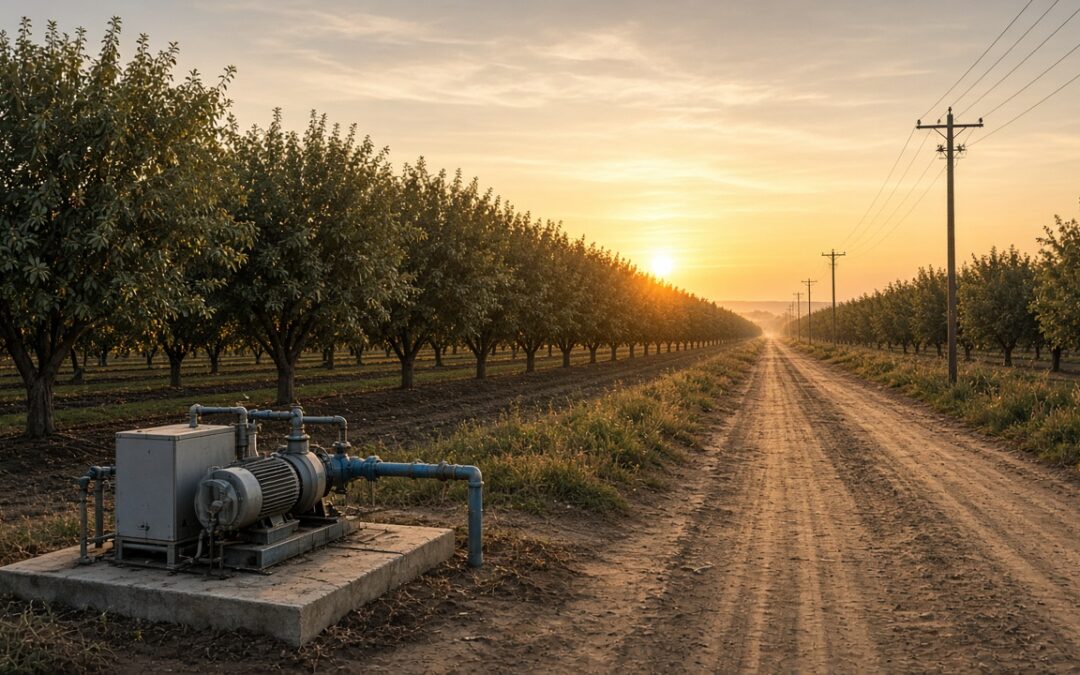
You drill a new well, set the pump, and call the utility to hook it up. Somewhere in that call you get asked which rate you want, and the answer decides what every hour of pumping costs for years. Pick the wrong one, or run the pump at the wrong time of day, and the well that was supposed to save the crop starts eating the margin.
The short answer to the question growers search most: yes, irrigation pumps can qualify for agricultural electric rates. But the ag rate is tied to how the meter is used, not to whether the service is new. And on today’s ag rates, when the pump runs matters almost as much as how long it runs.
This guide uses California’s two largest utilities, PG&E and Southern California Edison (SCE), as examples because their ag tariffs are public. Irrigation districts and municipal utilities set their own rules, so check your own tariff before you change anything.
Quick Takeaways
- The 70% rule. On both PG&E and SCE, a meter qualifies for ag rates when 70% or more of its energy goes to agricultural uses such as pumping water to irrigate crops.
- New service is the time to get it right. The utility asks for connected load and expected operating hours, and those answers steer which ag rate fits.
- Peak hours are short but expensive. PG&E ag rates have a 5 to 8 p.m. peak every day of the year. SCE ag rates use 4 to 9 p.m., with a 5 to 8 p.m. option.
- Demand charges punish spikes. One 15-minute burst of kW can set a charge for the whole month.
- A schedule only saves money if the pump actually follows it. That is where remote start, stop, and alerts earn their keep.
Do ag customers get special rates for new irrigation service?
They can. The test is not “new” versus “existing.” It is what the electricity on that meter does.
PG&E’s tariff (Rule 1 and Schedule AG) says a customer is served on an agricultural rate if 70% or more of the annual energy use on the meter is for agricultural end uses: growing crops, raising livestock, pumping water for irrigation of crops, or other uses that involve production for sale. Processing the crop does not count, and neither do a house, an office, or a retail stand on the same meter.
SCE uses the same 70% line. Its TOU-PA-2 and TOU-PA-3 schedules require that 70% or more of the account’s usage go to Agricultural Power Service, general water or sewage pumping, or oil pumping, with none of the remaining usage for domestic purposes.
So a dedicated irrigation well meter usually fits cleanly. A meter that also feeds a home, a shop, or a packing line is where growers get surprised.
What the utility will ask for when you start ag service
PG&E’s guide to starting agricultural service lists what to have ready:
- Panel inspection first. PG&E cannot set a meter until your local jurisdiction inspects and approves the electric panel.
- Connected load. Add up the horsepower or kW of everything on the meter. The nameplate on each pump motor has it.
- Total annual hours of operation. This is the number that steers you between the low-use and high-use rate options.
- Business documentation. Only legal businesses qualify for agricultural rates, and PG&E may ask for a business or state license.
PG&E also asks customers to tell it right away when they add load such as a new pump, since added demand may require an application.
If your new pump needs a power line run to it, the line extension is its own cost question. Under PG&E’s Rule 15, non-residential line extension allowances are calculated from the revenue the utility expects the new load to bring in, so a bigger, steadier pumping load can support a larger allowance. Ask about it before you sign for the extension.
How ag rates are built: energy, demand, and time of day
Most ag pumping rates in California are now time-of-use rates. Your bill has a few moving parts:
- Energy charges (per kWh) that change by time of day and season.
- Demand charges (per kW) based on the highest power draw in the month. Oregon State University Extension explains it well: demand is the power used at a moment in time, measured in kW, not the energy used over time in kWh.
- A customer charge that does not change with use.
That demand piece is the one that catches pumpers. PG&E notes its demand charge is calculated from the 15-minute interval in the billing month when you used the most power. Start two big pumps at once, or run a booster on top of the well pump for a quarter hour, and that peak can set the demand charge for the whole month.
How much do the hours matter? A University of California study published in California Agriculture found that peak-hour rates ran two to four times the off-peak rates under the TOU schedules of its day. Today’s ratios depend on your utility and rate, but the lesson holds: the clock is part of your water cost.
PG&E ag rates at a glance
PG&E’s default ag schedule (Schedule AG) has four options:
| Rate | Size | Best fit | Trade-off |
|---|---|---|---|
| AG-A1 | Under 35 kW | Under 1,300 operating hours a year | Lower demand charges, higher energy charges |
| AG-A2 | Under 35 kW | Over 1,300 operating hours a year | Higher demand charges, lower energy charges |
| AG-B | 35 kW and up | Under 1,500 operating hours a year | Lower demand charges, higher energy charges |
| AG-C | 35 kW and up | Over 1,500 operating hours a year | Higher demand charges, lower energy charges |
All four share the same peak: 5 to 8 p.m. every day, including weekends and holidays, year-round. Summer runs June through September, prices are higher in summer, and there is no partial-peak period. PG&E notes that only AG-C carries a summer peak demand charge, paired with a demand charge limiter.
If you can confine pumping to certain days, PG&E also offers Ag Flex options (AG-FA, AG-FB, AG-FC) that give you two off-peak days a week: Wednesday and Thursday, Saturday and Sunday, or Monday and Friday. Peak prices are modestly higher on the other days, so these fit operations that can plan around a fixed weekly pattern.
SCE ag rates at a glance
SCE splits its ag and pumping customers by size:
- TOU-PA-2 for demands below 200 kW.
- TOU-PA-3 for demands from 200 to 500 kW. Some larger accounts can stay on it if 70% or more of their energy is Agricultural Power Service.
On the standard SCE schedule:
- Summer (June 1 to September 30): on-peak is 4 to 9 p.m. on weekdays, and the same hours are mid-peak on weekends and holidays.
- Winter (October 1 to May 31): 4 to 9 p.m. is mid-peak every day, and 8 a.m. to 4 p.m. is super off-peak.
Ag customers can choose a 5 to 8 p.m. peak window instead of 4 to 9 p.m., which shrinks the expensive block to three hours.
Each SCE ag rate also comes in two flavors. Option D has both time-related and facilities-related demand charges with lower energy prices, and suits accounts that have to run through peak. Option E drops the time-related demand charge for higher energy prices, and SCE says it is best for customers who can shift use to off-peak hours.
Two more SCE details worth knowing. Business accounts that have been on a TOU rate for at least 24 months default each year to Critical Peak Pricing, which pays summer bill credits in exchange for higher prices during 12 to 15 event days, from 4 to 9 p.m., with notice the day before. And Schedule AP-I pays a credit to ag and pumping customers with 37 kW or more of demand, or at least 50 horsepower of connected load, who let SCE interrupt service during program events.
How to schedule irrigation pumps around time-of-use hours
Once you know your rate, the savings come from a handful of habits.
- Find your peak window and put it on the wall. 5 to 8 p.m. on PG&E ag rates. 4 to 9 p.m., or 5 to 8 p.m. if you chose it, on SCE. Every pump operator should know it.
- Start sets so they finish before peak. A 10-hour drip set that starts at 7 a.m. is done by 5 p.m. Start it at 10 a.m. and the last three hours land in the most expensive block.
- Use the cheap windows on purpose. On SCE’s winter schedule, 8 a.m. to 4 p.m. is super off-peak, which suits winter and pre-plant irrigation. Overnight hours are off-peak on both utilities.
- Stagger pump starts. Bringing two large pumps up within the same 15 minutes can set a new monthly demand peak. Give each one its own start time.
- Watch the event days. If you are on Critical Peak Pricing, a day-ahead event notice should change tomorrow’s pump plan.
- Fix the pump before you blame the rate. A worn pump or a falling water level means more kWh for the same acre-inch. Our post on well drawdown and pump level shows how to tell which one you are dealing with.
- Check the fit once a year. Operating hours change with crops and rainfall. SCE’s online rate comparison tool needs 12 months of usage data, and PG&E’s Agricultural Customer Service Center can walk through options.
The hard part is not the plan. It is the 4:55 p.m. phone call to someone who has to drive out and shut off a pump, and the night nobody can confirm it actually stopped.
Questions growers ask
Do ag customers get special rates for new irrigation service? Yes, when 70% or more of the meter’s energy goes to agricultural uses such as irrigation pumping, under both PG&E and SCE rules. The ag rate is based on how the meter is used, not on whether the service is new. New service is when you give the utility your connected load and operating hours, so it is the best time to land on the right ag option.
What are peak hours for agricultural electric rates in California? PG&E ag rates have a 5 to 8 p.m. peak every day of the year. SCE’s standard ag schedule is 4 to 9 p.m., with a 5 to 8 p.m. option. Other utilities and irrigation districts set their own hours.
Can a house and an irrigation pump share one ag meter? Only within the rules. PG&E allows up to 30% non-ag use as long as at least 70% is agricultural. SCE’s ag and pumping schedules require that none of the remaining energy go to domestic use. A separate meter for the pump avoids the question.
What is a demand charge on an ag pumping rate? A charge per kW based on the highest power draw during the billing month. PG&E measures it over 15-minute intervals, so one short spike from starting several pumps together can raise the whole month’s bill.
Is it cheaper to run irrigation pumps at night? On most ag time-of-use rates, overnight hours are off-peak. On SCE’s winter schedule the cheapest block is actually midday, 8 a.m. to 4 p.m. Read your own rate’s TOU chart before moving sets.
How AgriLynk Helps
A pump schedule saves money only if the pump follows it. AgriLynk remote pump and well control brings supported start, stop, timed runs, and scheduling to the dashboard, depending on your pump controller and electrical setup, so a set can end before peak without a drive across the farm. Flow and pressure readings and text or email alerts confirm the water actually stopped, and that it is moving again when the next set starts. Our earlier post on remote pump control covers what that looks like day to day.
On the valve side, the Control package adds timer and calendar-based irrigation scheduling, and Autonomous adds start and stop logic based on the soil moisture targets you set, so sets can be built around your rate’s cheap hours. See how it works, irrigation automation, and pricing. Every pump site is different, so AgriLynk reviews your controller, panel, and power before recommending a setup. Tell us about your pump or call (760) 723-1529.
Sources
- PG&E Electric Schedule AG, Agricultural Time-of-Use (tariff)
- PG&E Electric Rule 1, Qualification for Agricultural Rates (tariff)
- PG&E: How to Start Your Agricultural Service
- PG&E: Business and Agricultural Time-of-Use Rate Plans
- PG&E: Time-of-Use Rate Plans, agriculture section
- PG&E Electric Rule 15, Distribution Line Extensions (tariff)
- SCE: Agricultural and Pumping Rates
- SCE: Rate Schedule TOU-PA-2 fact sheet
- SCE: Rate Schedule TOU-PA-3 fact sheet
- University of California, California Agriculture: Furrow irrigation and TOU electric rates (1990)
- Oregon State University Extension EM 9713: Saving Water and Saving Energy