
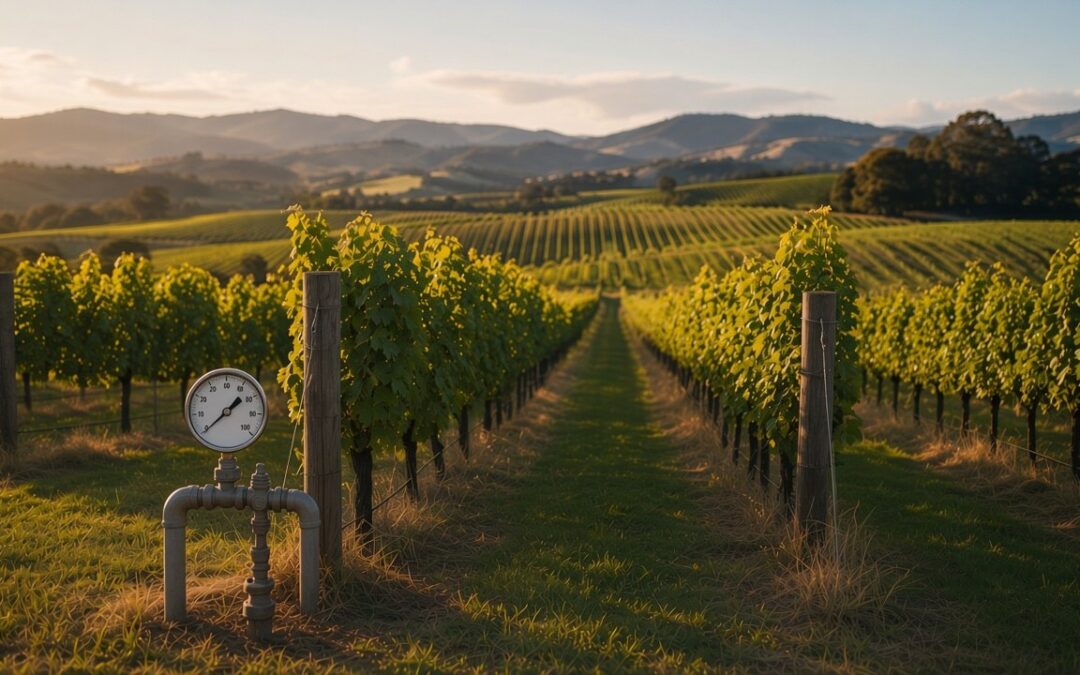
The schedule said the north block would get water from 10 p.m. to 1 a.m. The controller showed the set as complete. But the drip lines were dry when the crew drove past the next morning, because the valve never opened.
A week later the opposite happens. A valve that was supposed to close at 6 a.m. Saturday is still running Monday, and the low end of the block is standing in water.
Both problems look the same from the office: a schedule that says everything went to plan. Neither one shows up until somebody is standing in the field, and by then the crop has already gone short, or the extra water and the nitrogen it carried are already below the roots.
This post is about catching both kinds of failure early: why irrigation valves miss or overrun sets, how to know what a set should have applied, and the three field checks (pressure, flow, and soil tension) that tell you whether the water actually went where the schedule said it did.
Quick Takeaways
- A schedule is not proof. A controller can finish a program while the valve it was supposed to open stays shut, or stays open after the program ends.
- Do the math before the set. The irrigator’s equation (Q x t = d x A) tells you how many hours a set should run, and how much water an overrun really added.
- Overruns cost more than water. University of Nebraska Extension puts nitrate leaching losses at 5 to 10 lb per acre-inch of deep percolation or drainage.
- Pressure, flow, and soil tension each tell part of the story. Pressure shows whether the line came up and went back down. Flow shows whether the right amount moved. Soil tension shows whether the water reached the roots, or went past them.
- Know your baseline. Extension specialists recommend recording each zone’s flow and pressure when the system is new, so a change stands out.
Two ways a set goes wrong
A missed or short set means the block got less water than planned, or none. University of Arizona Cooperative Extension notes that too little water causes unnecessary water stress and can reduce yield. The risk is highest in peak summer and on light soils, where the root zone holds the least water in reserve.
An overrun set means the valve stayed open longer than planned. The same Arizona publication notes that too much water can cause waterlogging and leaching and may also reduce yield. University of Nebraska Extension adds the nitrogen side: nitrate leaching losses range from 5 to 10 lb per acre-inch of deep percolation or drainage, “which is why over-irrigation needs to be avoided.” They also point out that crop stress from late irrigation is easy to see, while the water and nitrogen lost to over-irrigation “are not nearly as visible.”
That last point is the real problem. A missed set usually shows up as stress within days. An overrun can go unnoticed all season.
Why valves miss sets
Most automated irrigation valves are solenoid-operated diaphragm valves. As University of Florida IFAS Extension describes them, the solenoid uses an electromagnetic force to start a piloting action that lets line water open the valve. When something in that chain breaks, the valve stays closed even though the controller thinks it sent the signal.
A valve troubleshooting guide from irrigation manufacturer Rain Bird lists the usual suspects for a valve that will not open:
- Water supply or an isolation valve is off. Check the obvious first.
- The controller or wiring is the problem. If the valve opens with the manual bleed but not from the controller, look at the controller, the program, or the wire run.
- The solenoid is burned out. A resistance test with a meter will tell you.
- Plugged ports. The small ports that relieve water from above the diaphragm can clog, so the valve never gets the signal to open.
- The flow control stem is turned all the way down. An adjustment problem, not a broken part.
In the field, add the farm-specific causes: a dead battery on a battery-operated controller, a pump that did not start, a filter station that plugged so pressure never built, or a schedule that was paused after rain and never turned back on.
Why sets overrun
A valve that will not close is often a debris problem. Irrigation manufacturer Hunter Industries calls debris the most common reason a valve stays on or weeps. The Rain Bird guide lists rocks or other debris that keep the diaphragm from seating, a plugged diaphragm filter, a plunger that is stuck or missing, an open manual bleed, a large hole in the diaphragm (on forward-flow valves), a controller that keeps sending voltage, and a flow control turned up so high that the diaphragm sticks open under low flow or low pressure.
Hunter names the usual sources of that debris: new installations that were not flushed properly, a recent mainline repair, and well water. A valve that closes most of the way but still lets some water through is said to be “weeping” or seeping. Rain Bird notes it usually shows up as a puddle at the lowest outlet after the set ends.
Then there are the human causes: a manual set that someone meant to shut off, a schedule left at peak-summer run times into fall, or two programs that overlap and keep a valve open longer than either one on its own.
Check 1: Know what the set should apply
Before you can tell if a set went wrong, you need to know what “right” looks like. University of Arizona Cooperative Extension uses the irrigator’s equation:
Q x t = d x A
where Q is flow, t is set time in hours, d is depth applied in inches, and A is area in acres. With Q in cubic feet per second, the units work out directly. Arizona notes that 450 gallons per minute equals 1 cubic foot per second, so with a pump rated in gallons per minute:
Depth applied (inches) = gpm x hours / (450 x acres)
Set time (hours) = 450 x acres x inches / gpm
Here is our own example using that formula. A 20-acre drip block supplied at 300 gpm needs 450 x 20 x 0.5 / 300 = 15 hours to apply half an inch.
Now say that valve sticks open for an extra 48 hours over a weekend. That is 300 x 48 / (450 x 20) = 1.6 extra inches on the block. If the root zone was already full, much of that extra water can move below the roots. At Nebraska’s 5 to 10 lb of nitrate per acre-inch of deep percolation, that weekend could carry roughly 8 to 16 lb of nitrogen per acre out of reach. Your soil, crop, and system will change the numbers, but the scale is the point.
Write the expected set time and the expected gallons (gpm x minutes) next to each block on the schedule. When the real numbers do not match, you have a problem to look for.
Check 2: Watch pressure during and after the set
Pressure is the fastest sign that a valve actually opened. When the set starts, the line downstream of the valve should come up to its normal operating pressure. When the set ends, it should drop back down.
Read it both ways:
- Pressure never comes up during the scheduled window: the valve did not open, or no water reached it (pump, filter, or supply problem upstream).
- Pressure comes up but stays low: something is open that should not be, or the supply is short. Our low irrigation pressure checklist walks the causes in order.
- Pressure stays up after the set should have ended: the valve did not close, or the controller is still running it.
A single gauge read once a day will miss most of this. A set that failed at 2 a.m. and a valve that stuck open on Saturday both happen when nobody is standing at the gauge.
Check 3: Compare flow to what the set should use
Flow tells you whether the right amount of water moved, not just whether the line was pressurized. UC Agriculture and Natural Resources notes that the most reliable flow information comes from the change in a flow meter’s totalized reading over a known time period. For example, 30,000 gallons through a meter in one hour is 500 gpm.
For each set, compare the gallons the meter recorded to the gallons the set should have used. Then read the flow and pressure together. NC State Extension’s guidance for drip systems:
- Pressure suddenly drops and flow increases: you likely have a leak (holes in dripline, broken fittings).
- High pressure with low flow: points to emitter clogging or collapsed driplines.
- A gradual decline in flow: emitters are slowly clogging.
UC ANR adds one important rule: compare flow readings taken at the same operating pressure, or the numbers are hard to compare. For more on what slipping flow can mean, see why your irrigation flow rate may be lower than normal.
Check 4: Let the soil confirm it
Pressure and flow tell you water moved through the pipe. Soil sensors tell you whether it reached the roots and stopped there.
Oregon State University Extension recommends monitoring at more than one depth, noting that multidepth monitoring lets you detect over-irrigation (deep percolation), shallow drying, and root-zone depletion patterns.
In practice, you’d generally expect:
- After a normal set, the shallow sensor’s soil tension should drop (wetter) within hours, and the deeper sensor should respond less or later.
- If the shallow sensor never responds, the water did not arrive, even if the schedule says the set ran.
- If the deepest sensor goes wet after set after set, the sets are running long enough to push water below the root zone.
Sensor placement matters as much as the reading. See where to place soil moisture sensors and how to read soil tension for scheduling.
Quick diagnosis table
| What you see | Likely cause | What to check first |
|---|---|---|
| No pressure rise during the scheduled set | Valve did not open, or no water reached it | Supply and isolation valves, controller program, manual bleed test, solenoid |
| Pressure rises, flow total far below expected | Partial opening, clogging, or a short set | Flow control stem, filters, emitters, actual run time |
| Pressure drops and flow jumps mid-set | Leak or line break | Walk the block for broken fittings or dripline |
| Pressure stays up after the set should end | Valve stuck open or still being powered | Debris on the diaphragm seat, open manual bleed, controller output |
| Puddle at the low end after shutoff | Valve weeping | Diaphragm, seat, and solenoid plunger |
| Shallow soil tension never drops | Water never reached the roots | Pressure and flow records for that set |
| Deep sensor wet after every set | Sets running too long | Set time math, schedule overlaps |
Use the off-season to set baselines
Late fall and winter are a good time to service valves before next season: clean diaphragm screens and ports, check solenoids, and flush lines after any mainline repair. NC State Extension recommends documenting flow rate and operating pressure in each zone while the system is relatively new, then recording both regularly so you can compare against that baseline. If you do not have a baseline yet, record one on the first normal sets of spring.
Questions growers ask
How do I calculate how long to run an irrigation set? Use the irrigator’s equation. With flow in gallons per minute, set time in hours = 450 x acres x inches / gpm. A 20-acre block at 300 gpm needs 15 hours to apply half an inch.
Why is my irrigation valve not closing? Debris keeping the diaphragm from seating is a common cause. Other causes include a plugged diaphragm filter, a stuck solenoid plunger, an open manual bleed, a damaged diaphragm, a controller still sending voltage, or a flow control turned up too high.
Why won’t my irrigation valve open? Check the water supply and isolation valves, then try the manual bleed. If it opens by hand but not from the controller, look at the controller and wiring. If it will not open by hand, check the flow control stem and look for plugged ports or a burned-out solenoid.
How can I tell if a valve is weeping? Look for a puddle at the lowest point in the block after the set has ended, or a flow meter total that keeps creeping up after the valve should be closed.
Can soil moisture sensors catch an overrun set? Yes, if you have a sensor below the main root zone. Oregon State University Extension notes that monitoring at multiple depths helps detect over-irrigation through deep percolation.
How AgriLynk Helps
AgriLynk does not repair a stuck valve, but it helps you know about one sooner. Every starter package includes a pressure sensor, so pressure readings on the dashboard show whether a line came up during a set and dropped after it. Flow sensors can be added as expansion modules, and soil tension sensors show whether the water reached the root zone. Field stations report every 8 minutes, with email and SMS alerts routed to the right people, plus an alert if a station stops reporting. You can also set custom pressure alerts, for example if line pressure doesn’t come up when a set should be running or stays up after it should have ended.
With Control, you can open and close supported valves from your phone, tablet, or computer and run timer and calendar schedules. With Autonomous irrigation, supported valves can start and stop irrigation based on the soil tension targets and watering window you set. One field station controls one valve, and most irrigation solenoids are supported (tell us what you have and we will confirm). For the bigger picture on remote valves, see when remote valve control makes sense.
Tell us which block worries you most. Get my farm’s quote or call (760) 723-1529.
Sources
- University of Arizona Cooperative Extension: Determining the Amount of Irrigation Water Applied to a Field (AZ1157)
- University of Nebraska-Lincoln Extension: Irrigation and Nitrogen Management (EC2008)
- University of Florida IFAS Extension: Valves in Irrigation Systems (CIR824)
- UC Agriculture and Natural Resources: Maintenance of Microirrigation Systems, Flow Meters
- NC State Extension: Critical Management Issues for SDI Systems in North Carolina
- Oregon State University Extension: Soil Moisture Monitoring to Support Irrigation Scheduling (EM 9868)
- Hunter Industries: Valves, Valve Not Closing (manufacturer reference)
- Rain Bird: Irrigation Troubleshooting Guide (manufacturer reference)