
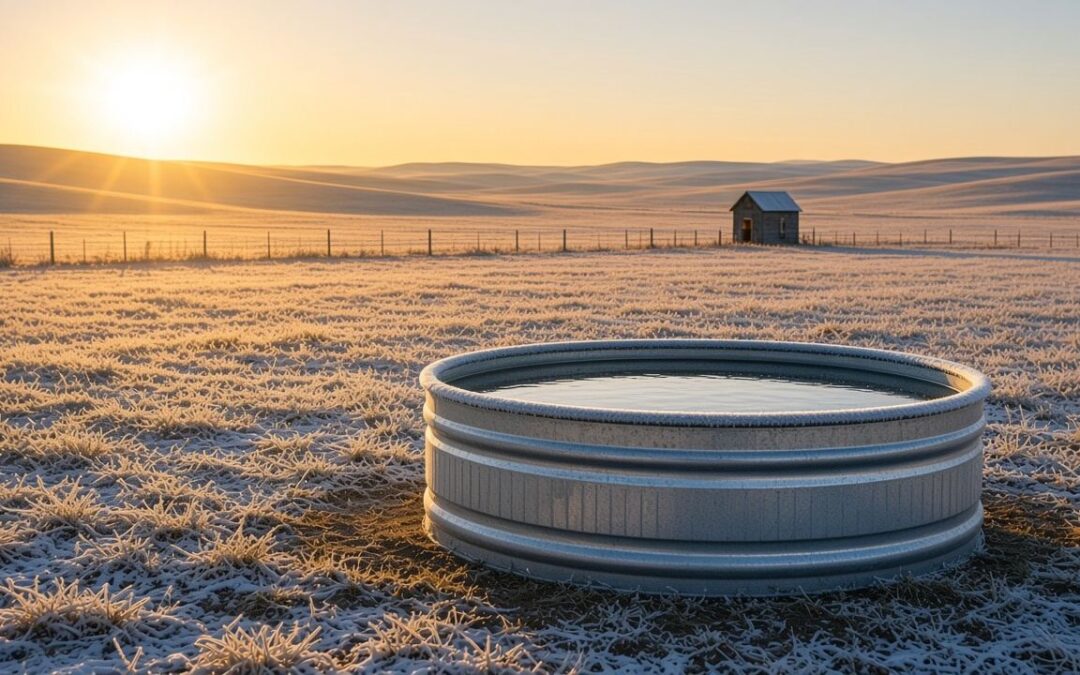
When the grass goes dormant and the mornings turn cold, it is easy to think the water job gets lighter. Cattle do drink less in winter than in August. But they still need liquid water every day, and winter adds problems summer never has: ice on the tank, heaters that quit, frozen lines, and roads that make the daily check slower.
Here is how much water cattle need in cold weather, why snow is not a plan, and a winter checking routine that catches trouble early.
Quick Takeaways
- Rule of thumb: about 1 gallon per 100 pounds. SDSU Extension says mature cattle need about 1 gallon of liquid water per 100 pounds of body weight in winter.
- Lactating cows need far more. In NDSU’s table, a 900-pound lactating cow needs about 11.4 gallons a day at 40°F, compared with 6.7 for a 900-pound pregnant cow.
- Less water means less feed. Water intake is closely tied to feed intake, and cows need to eat well on dormant winter forage.
- Snow is an emergency backup, not a water source. Extension specialists warn some cows will not eat enough snow, and melting it costs body energy.
- Common winter failures are mechanical. Ice, stuck floats, failed heaters, outages, and stray voltage can keep cattle from water that is there.
How much water do cattle need in winter?
North Dakota State University Extension publishes daily water estimates for beef cattle by weight, stage of production, and temperature. The coldest row in its table is 40°F. At that temperature, NDSU estimates:
| Animal (at 40°F) | Gallons per head per day |
|---|---|
| 600-lb growing calf | 5.3 |
| 900-lb pregnant cow | 6.7 |
| 1,110-lb pregnant cow | 6.0 |
| 900-lb lactating cow | 11.4 |
| 1,600-lb mature bull | 8.7 |
Source: NDSU Extension AS1763, adapted from the NRC Nutrient Requirements of Beef Cattle (2016).
For a quick herd number, SDSU Extension’s rule of thumb is simpler: mature cattle need about 1 gallon of liquid water per 100 pounds of body weight. A 1,200-pound cow works out to about 12 gallons a day by that rule. That rule of thumb runs higher than NDSU’s 40°F table, so it leaves some margin.
Run the math for your herd before the first hard freeze. Fifty 900-pound pregnant cows at NDSU’s 40°F estimate need about 335 gallons a day. If calving starts and those cows begin nursing, the same cows move toward the lactating column, and the daily total climbs fast.
Why it matters: SDSU points out that water intake is highly correlated with feed intake. Dormant winter forage is lower quality, so you want cows eating at full capacity. A cow that cannot drink will not eat like she should, and NDSU notes that a 10% loss of body water is fatal to most domestic livestock.
Can cattle live on snow in winter?
Not reliably. Cattle will eat clean snow, and it can cover part of their water need for a while. But extension guidance is consistent that it is a fallback, not a plan:
- NDSU says snow may be considered a water source in an emergency, if it is soft and fluffy and not crusted or icy. Some animals do not adapt to eating snow and become dehydrated, and thawing and warming snow to body temperature uses up the cow’s energy. NDSU adds that little research exists on snow as a water source.
- SDSU notes you cannot always count on snow being there, and some cows will not eat enough of it to meet their needs.
The bottom line from SDSU: always provide a source of liquid water.
What stops cattle from drinking in winter
Water in the tank is not the same as water a cow can drink. These are the common winter failures extension specialists warn about.
Ice on the surface. SDSU notes cattle may break thin ice, but once it gets too thick, they cannot. NC State warns that extended cold can leave a tank full of ice with no room for water.
Heaters and automatic waterers that quit. NC State says automatic waterers meet the herd’s needs as long as they keep working normally, and a failed heater or a lid that does not close properly can freeze up fast. NDSU recommends checking water temperature to make sure thermostats are working and not drifting to higher temperatures.
Power outages. SDSU recommends a backup power source for any electrically heated tank.
Stray voltage. SDSU advises checking periodically for electrical shorts running through the water supply, and NC State warns about shorts or bare wire on electric waterers and tank heaters. NC State notes that stray voltage of just a few volts can keep cattle from drinking. If cattle hang back from a tank that has open water, check for it.
Floats and lines. Ice can hold a float open or keep it shut, and buried lines can freeze. We covered how floats fail and what a level reading can and cannot see in our post on trough cameras vs. tank sensors.
A winter water-checking plan that works
NDSU says water fountains and tanks should be checked every day during severe cold, and NC State advises checking automatic waterers daily. With remote pastures and short days, a plan helps you spend those miles where they count.
- Know each tank’s daily draw. Multiply head count by the NDSU or SDSU estimate. That tells you how many hours or days of storage each tank holds if the supply stops.
- Rank your water points. Tanks with the least storage, the most cows, lactating cows, or a long drive go to the top of the list.
- Know what a level reading can and cannot tell you. A level that keeps dropping and never recovers points to a supply, line, or float problem. On a float-fed tank, a steady level is normal, so it cannot tell you whether cattle are drinking. On a tank with no refill, a level that does not drop while cows are on that pasture means water is not leaving the tank, but the reading cannot tell you why: ice, stray voltage, and cattle that are off water all look the same. Either case needs eyes on it.
- Plan for the bad day. Decide ahead of time who hauls water, from where, and how, if a well, line, or heater fails during a storm.
- Still go look. Ice, a shocking heater, and a frozen lid are things you see in person. Use data to choose which tank gets checked first, not to skip the check.
For help choosing thresholds for low tank levels and silent stations, see which custom alerts matter on a remote well or stock tank.
Questions ranchers ask
How many gallons of water does a cow drink per day in winter?
NDSU estimates about 6 to 7 gallons a day for a 900- to 1,110-pound pregnant cow at 40°F and about 11.4 gallons for a 900-pound lactating cow. SDSU’s rule of thumb is 1 gallon per 100 pounds of body weight.
Can cattle get enough water from eating snow?
Not reliably. NDSU treats snow as an emergency water source, and then just when it is soft and fluffy, not crusted or icy. Some cows will not eat enough, and melting snow costs them energy.
Why are my cows not drinking from a full tank?
Check for ice they cannot break, a frozen or stuck lid, and stray voltage from a heater or waterer. NC State notes a few volts can keep cattle from drinking.
How often should I check stock tanks in winter?
NDSU says water fountains and tanks should be checked every day during severe cold, and NC State recommends checking automatic waterers daily. Remote readings can help you decide which tank to check first.
How AgriLynk Helps
AgriLynk does not heat a tank, break ice, or replace the daily ride. It helps you see your water points between trips. With remote stock tank monitoring, you can track supported tank levels from a dashboard in any browser on your phone, tablet, or computer. Field stations report every 8 minutes. You can set custom alerts at the levels you choose, route them by email or text to the right people, and get an alert if a station stops reporting. Twelve months of history is included, so you can learn what each tank’s normal draw looks like.
A level reading measures depth. It cannot tell you whether the surface is frozen or whether a cow is getting shocked, so keep looking in person, and use the data to pick which pasture needs you first.
An isolated tank can use a solar- and battery-powered cellular field station with no farm gateway, where there is compatible cellular coverage. Several nearby tanks can share one gateway, which needs power: a standard 110-volt outlet, or the enhanced outdoor gateway with a battery/solar option. Each layout is quoted. If you also want wells, pumps, reservoirs, or more than one farm on the same system, that is usually an Enterprise / Farm Network conversation. See pricing, then tell us how many tanks you water from and how far apart they are. Or call (760) 723-1529.
Sources
- North Dakota State University Extension: Livestock Water Requirements (AS1763, revised February 2026)
- North Dakota State University Extension: Winter Management of the Beef Cow Herd
- South Dakota State University Extension: Icebreakers: Winter Water Supply (updated January 4, 2024)
- NC State Extension, Wilkes County Center: Livestock and Snow: If You Are Cold, They Probably Are Too! Management Tips (updated January 24, 2025)