
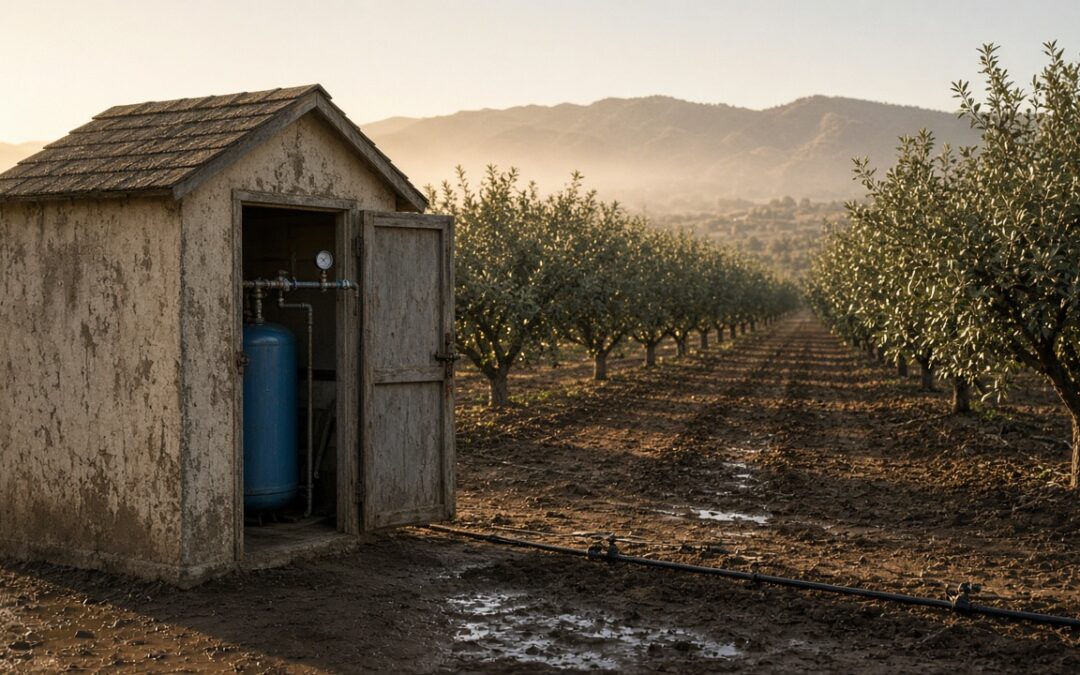
You are filling a stock tank or running a small drip block off the farm well, and you can hear the pump house from across the yard. The pressure switch clicks, the motor hums for a few seconds, the switch clicks again, and the pump stops. Ten seconds later it starts over.
That pattern is called short cycling. Water still comes out, so it is easy to ignore. But every start heats the motor and wears the controls on a pump that may sit hundreds of feet down a well, and those starts add up fast.
Here is how a pressure-switch well system is supposed to cycle, what makes it start too often, why that costs you, and the readings that help sort a tank problem from a well problem before you call the pump company.
Quick Takeaways
- The pressure tank sets the rhythm. Its air cushion lets the pump run, fill the tank, and rest. Without it, the pump hits shutoff pressure in seconds.
- Four plumbing causes lead the list. A major submersible motor maker’s troubleshooting table blames a motor that starts too often on the pressure switch, a check valve stuck open, a waterlogged tank, or a leak.
- Starts wear motors out. The same manual links excessive cycling to shorter control life, spline and bearing damage, and overheating, and calls for at least one minute of run time per start.
- The well can cause it too. A pump that outruns the well’s yield pulls the water level toward the intake, where a low-water cutoff or protection device may stop it.
- Watch pressure, starts and run time, well water level, and power use. Together they point to the tank, the switch, the plumbing, or the well.
How a pressure-switch well system is supposed to cycle
Many farm wells that feed a house, shop, livestock water, or a small irrigation line use the same three parts: a pump, a pressure tank, and a pressure switch.
Washington State Department of Health’s guide to bladder pressure tanks walks through a normal cycle. With the pump off, the tank is nearly empty and the air inside expands. When pressure drops to the switch’s start setting, the pump comes on and pushes water into the tank, compressing the air. When pressure reaches the cutoff setting, the pump stops. As water is used, the compressed air pushes it out, and the cycle starts again. Common pressure ranges are 30 to 50 psi or 40 to 60 psi.
University of Nebraska-Lincoln Extension describes the pressure tank as a reserve that lets the pump “start and stop less often, prolonging the life of the pump.” The tank only does that job when its air charge is right. UNL and Washington State both say the air pressure in a drained tank should be 2 psi below the pump’s start pressure: 28 psi for a 30 psi start setting.
A pressure tank holds less usable water than its size suggests. Penn State Extension notes that only about 20 percent of a pressure tank’s capacity is usable, so a 42-gallon tank discharges about 8 gallons before the pump starts. UNL’s sizing table, adapted from the MidWest Plan Service Private Water Systems Handbook, shows a 14-gallon bladder tank holding about 3.7 usable gallons on a 40 to 60 psi switch.
Why short cycling wears out pumps and wastes energy
Franklin Electric’s 2026 AIM Manual for submersible motors, a standard installer reference, is direct about the cost of starts:
- Excessive cycling reduces the life of control components and can cause motor spline damage, bearing damage, or motor overheating.
- Motors should run a minimum of one minute to get rid of the heat built up by starting current.
- Six-inch and larger encapsulated motors without a reduced voltage starter or VFD should have at least 15 minutes between starts or starting attempts.
- Pump size, tank size, and controls should be chosen to keep starts per day as low as possible.
The manual also lists maximum starts per 24 hours by motor size:
| Motor size | Single-phase | Three-phase |
|---|---|---|
| Up to 0.75 hp | 300 | 300 |
| 1 to 5.5 hp | 100 | 300 |
| 7.5 to 30 hp | 50 | 100 (up to 200 with a properly configured reduced voltage starter or VFD) |
| 40 to 200 hp | Not listed | 100 |
Spread over a day, 100 starts works out to about four an hour. A pump that kicks on every 30 seconds while a trough fills is starting 120 times an hour. That is our arithmetic, not a manufacturer rating, but it shows how quickly a cycling pump blows through its budget.
Washington State’s guide agrees: “Frequent starts and stops can damage facilities,” and lost tank air “will lead to excessive pump cycling, which may shorten the life of the well pump motor.”
Energy is the quieter cost. UNL Extension notes that a conventional pressure-switch system typically starts the pump more times than a variable frequency drive (VFD) system, “using more energy.” And when the cause is a leak, the pump is spending power to move water nobody uses. If you have been working on irrigation pump efficiency and kWh per acre-foot, short cycling is one more way the power bill can climb without any extra water reaching the crop.
What causes a well pump to short cycle
1. A waterlogged pressure tank or lost air charge
This is the usual suspect. Washington State’s guide explains that when the bladder inside the tank fails, water fills the air space and the tank becomes waterlogged. Signs include:
- The pump cycles on and off rapidly.
- The tank feels heavy when gently tipped, or sounds different when you tap it.
- Water comes out when you press the pin on the air valve.
- Stale or rusty water appears at the tap from corrosion inside the tank.
Even without a failed bladder, tanks lose air slowly, like a tire. UNL puts it simply: if the pump runs only a few seconds and then shuts off, there is not enough air in the tank. Washington State notes it is often most cost-efficient to replace a waterlogged tank, and puts the average bladder tank’s life at 5 to 7 years.
2. Pressure switch settings or a worn switch
UNL says the start point is often 30 or 40 psi and the stop point is usually about 20 psi higher. For a motor that starts too often, the AIM manual’s troubleshooting table says to check the switch for welded contacts and check its adjustments. UNL is clear that the switch is connected to electric power and that a licensed professional should do any work on it. And because the tank’s air charge is set from the start pressure, changing one without the other throws the system out of step.
3. A check valve stuck open
A check valve keeps water from draining back down the well when the pump stops. If it sticks open, pressure bleeds off with nothing running and the pump restarts. The AIM manual lists “check valve stuck open” under motors that start too often. UNL gives a simple test: shut off water use and watch the pressure gauge. If it holds steady, the check valves and lines are fine. If it drops, there is a leak or a check valve problem.
4. Leaks in the system
A leaking line, a float valve that never fully closes, or a broken fitting at a trough all look the same to the pressure switch: falling pressure. UNL notes that a soggy area along a buried line can point to a break. On long runs to stock tanks or field hydrants, leaks are easy to miss.
5. A tank that is too small for the pump
Take UNL’s 14-gallon bladder tank holding about 3.7 usable gallons on a 40 to 60 psi switch. A pump delivering 10 gallons per minute refills that in about 22 seconds, well short of the AIM manual’s one-minute minimum. That is our calculation from the two sources, but it shows why a tank that worked for a house can cycle hard once the well feeds a bigger pump or an irrigation line.
Small, steady demand can do the same thing. A drip block or trough float drawing a few gallons a minute from a pump sized for much more lets the tank fill fast and drain slowly, so the pump tops it off in short bursts. Utah State University Extension lists loads that vary on a single pump, such as zones with random start times, as a main case where a VFD makes sense, and notes that a correctly installed VFD can decrease electrical system stress and extend pump life.
6. Low well yield and drawdown
Sometimes the problem is in the well, not the plumbing. Penn State Extension defines well yield as the maximum rate a well can be pumped without lowering the water level below the pump intake. When a pump moves water faster than that, the level drops toward the intake.
Penn State recommends a low-water cutoff, controlled by water-level sensors in the well, that overrides the other pump controls and stops the pump before air or sediment is pulled in. A cutoff or protection device that stops the pump and lets it restart once water comes back can produce an on-off pattern that looks like a tank problem. Fixing the tank will not help, because the limit is how fast the well refills. Our guide to well drawdown and pump level goes deeper on this.
Quick diagnosis: what the pump is telling you
| What you see | Likely cause |
|---|---|
| Pump runs only a few seconds, gauge swings fast between start and stop pressure | Waterlogged tank or low air charge |
| Water comes out of the tank’s air valve | Failed bladder; replace the tank |
| Pressure falls with no water being used | Check valve stuck open or a leak |
| Tank charge and pressure hold both check out, but the pump still starts too often | Pressure switch contacts or adjustment |
| Cycling gets worse during long or heavy pumping, and the well’s water level drops toward the intake | Pump moving water faster than the well yields |
| Cycling mostly when a small zone or trough is the only demand | Tank too small for the pump, or demand well below pump output |
What to monitor to catch short cycling early
Short cycling usually creeps in as a tank loses air or a check valve starts to weep. The sooner you spot the trend, the more motor life you keep.
- Pressure. Note how fast the gauge swings between start and stop, and whether pressure holds when nothing is running. UNL’s hold test is the quickest way to separate a leak or check valve problem from a tank problem.
- Run time and starts. Count starts in an hour and time each run. Compare that with the motor’s rated starts per day and the one-minute minimum.
- Well water level. If the level holds steady while the pump cycles, look at the tank, switch, and plumbing. If it falls toward the intake every time the pump runs, the well is the limit.
- Power use. Energy readings from a VFD or pump controller show the cost of a pump that never settles into a steady run.
- Flow, if you have a meter. Gallons pumped versus gallons you meant to use is the clearest leak check.
Alerts work better when you know what normal looks like at each site. Our post on custom alerts for wells and tanks covers picking thresholds that catch real problems.
Fixes, in the order most pump pros check them
- Check the tank’s air charge. With the pump off and the tank drained, it should be 2 psi below the start setting. Follow the manufacturer’s safety instructions, as Washington State’s guide stresses, or bring in a professional. Replace a waterlogged tank.
- Rule out the switch, check valve, and leaks. Have a licensed professional check the switch, run the pressure hold test, then walk the lines, floats, and hydrants.
- Right-size the tank. If the pump still cannot run a full minute per start, more tank capacity gives it more usable water between starts. Penn State notes that larger pressure tanks alone will not solve a low-yield well.
- Match the pump to the well. For a low-yield well, Penn State describes a well pump sized slightly below the well’s yield filling a storage tank more or less continuously, with a low-water cutoff to protect the pump.
- Consider a VFD where demand varies. Utah State and Oregon State University Extension both list multiple flow or pressure conditions on one pump among the situations where a VFD works well. Oregon State suggests talking with your pump dealer or power company, and notes incentives may be available through your local utility.
Questions growers ask
What does it mean when a well pump short cycles? The pump starts, runs briefly, and shuts off over and over instead of running a steady cycle. On a pressure-switch system the usual cause is a tank that has lost its air charge or become waterlogged, so pressure hits the cutoff in seconds.
How many times an hour should a well pump start? It depends on the motor. Franklin Electric’s AIM manual lists maximum starts per 24 hours by size, for example 100 a day for a 1 to 5.5 hp single-phase motor, and says each run should last at least one minute. Fewer starts mean longer life.
Can a bad pressure switch cause short cycling? Yes. The AIM manual lists the pressure switch among the causes of a motor that starts too often, pointing to welded contacts and incorrect adjustments. Because the switch is connected to electric power, have a licensed professional inspect or adjust it.
How do I know if my pressure tank is waterlogged? Rapid cycling, a tank that feels heavy or sounds different when tapped, and water coming out when you press the air valve pin. A waterlogged tank usually needs replacing.
Can low well yield make a pump cycle on and off? It can. If the pump outruns the well, the water level drops toward the intake and a low-water cutoff or protection device may stop the pump until the level recovers. Watching well water level during pumping separates a well problem from a tank or switch problem.
How AgriLynk Helps
AgriLynk does not fix a waterlogged tank or replace your pump company. It helps you see the pattern sooner, without a drive out to the pump house. With pump and well control, you can check supported pump readings from the dashboard, and configured alerts help your team react when pressure, flow, or other supported conditions fall outside expectations. With a flow sensor, the flow history on your dashboard shows when water was moving, so you can track how long your pump ran over time. Where supported, AgriLynk can also read your pump’s power and energy use from a compatible VFD or pump controller. AgriLynk supports pump controllers, VFDs, and flow meters, and we confirm your specific equipment during quoting.
Remote well monitoring brings well water level into the same dashboard, so a well that keeps drawing down shows up as a trend instead of a surprise. Field stations report every 8 minutes, so the dashboard is better for spotting trends over hours and days than for timing each individual start. You can set custom alerts at the thresholds you choose, route them to the right people, and get an alert if a station stops reporting.
A single remote well can start with a cellular field station where there is compatible cellular coverage. Standard gateways plug into a regular 110-volt outlet. For sites without power, the enhanced outdoor gateway is available with a battery/solar option. Several wells, pumps, or more than one farm are usually Enterprise / Farm Network setups. See pricing, tell us about your pump, or call (760) 723-1529.
Sources
- Franklin Electric: AIM Manual, 60 Hz Submersible Systems, 2026 Edition (manufacturer reference; copy hosted by the Nebraska Department of Water, Energy, and Environment)
- Washington State Department of Health: Drinking Water Tech Tips, Troubleshooting Bladder Pressure Tanks (DOH 331-342)
- University of Nebraska-Lincoln Extension: Private Drinking Water Wells: Operation and Maintenance for Mechanical Components (G2153)
- Penn State Extension: Using Low-Yielding Wells
- Utah State University Extension: Variable Frequency Drives for Irrigation Pumps
- Oregon State University Extension: Saving Water and Saving Energy (EM 9713, April 2026)