
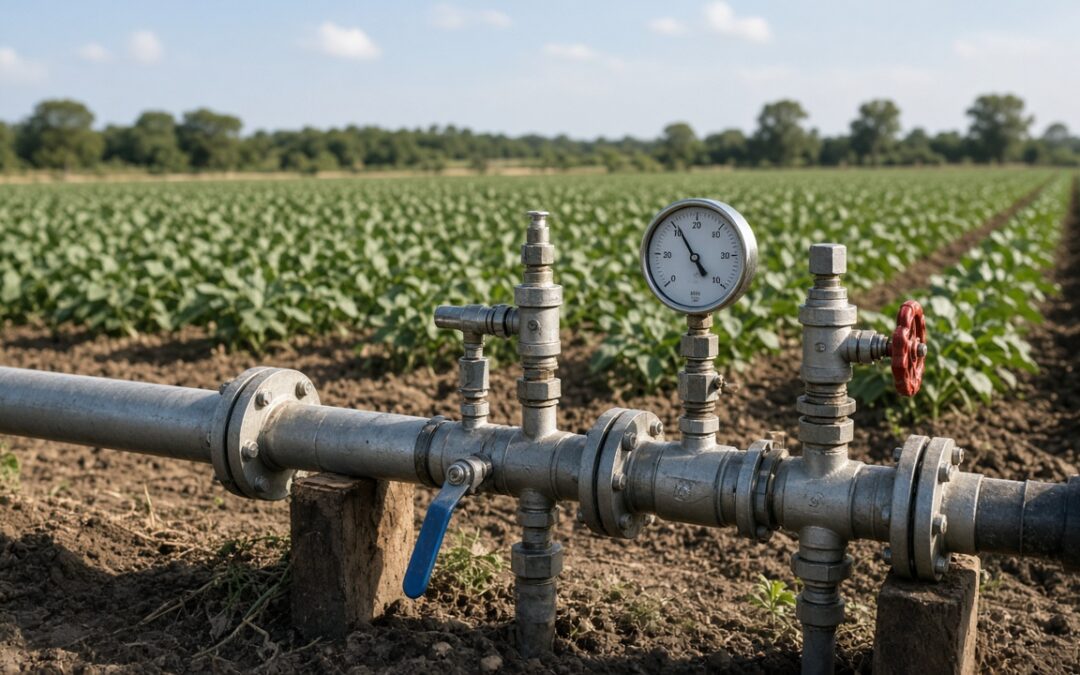
Sprinklers that used to throw now limp. The far end of a drip block looks dry while the head looks fine. A gauge that used to sit at a familiar number is suddenly soft.
Low Irrigation Pressure: Common Causes and How to Find the Problem covers the main causes and why pressure plus flow beats a single gauge glance. This post is the ordered checklist—what to check first in the field, including elevation and demand, before you rewrite the schedule or blame the pump.
Quick Takeaways
- Clean filters and confirm valves before you call a pump tech.
- Read inlet and outlet pressure across the filter; a rising differential usually means service the filter, not the crop.
- Elevation and “too many sets at once” create the same symptom as a weak pump.
- Intermittent night drops need a log, not a mid-morning gauge check.
Pressure + flow cheat sheet
| If you see… | Look first at… |
|---|---|
| Low pressure + high flow | Leak, broken line, stuck-open valve |
| Low pressure + low flow | Filter, restriction, partially closed valve, pump or supply limit |
| OK near the pump, soft farther out | Elevation, undersized pipe, restriction, or leak between those points |
| Soft only on certain sets | Excess demand, one bad valve, or intermittent clog |
University of Arkansas Extension’s drip troubleshooting note lists dirty filters, leaks, and valve position among the first places low line pressure shows up. North Carolina Extension’s drip operations checklist treats about 5 psi difference across a filter as a clean/backwash trigger. FAO micro-irrigation guidance uses a similar idea (~0.5 bar / ~7 psi). Use the manufacturer’s number when you have one; the point is the same: do not guess when the filter is choking.
The checklist (walk it in this order)
1. Safety and “is water actually moving?”
- Confirm the pump or supply is powered and intended to be running.
- Confirm the correct zone valves are commanded open.
- Confirm you are not reading a gauge on a dead-ended or shut-off branch.
2. Filters (most common fixable cause)
- Read pressure before and after the primary filter (and secondary filter if you have one).
- If the differential is at or above your service threshold (~5–7 psi for many sand/screen setups), clean or backwash before anything else.
- Inspect for torn screens or media that lets grit through—downstream emitters will clog and pressure behavior gets weird.
3. Valves and regulators
- Verify each valve in the path is fully open, not “looks open.”
- Listen for stuck solenoids; check for debris on diaphragms when you can do so safely.
- Confirm pressure regulators are oriented correctly and not failed open/closed.
- On manifolds, make sure the set you think is running is the set that is actually open.
4. Elevation and layout
- High ground and long laterals need more pressure at the source to stay in range at the far end.
- A block that used to work can go soft after a layout change, a new high set, or a longer main run.
- Compare a reading at the pump discharge with a reading at the high point and at the far end while the same set is running.
5. System demand (“too much open at once”)
- Shut off extra zones. If pressure recovers, the pump and pipe are being asked for more than they were designed to deliver.
- Check whether night schedules stacked sets that used to run separately.
- Adding valves without revisiting pump capacity is a common quiet cause of “sudden” low pressure.
6. Leaks and pipe restrictions
- Walk visible mains, fittings, and valve boxes for wet spots, hissing, or washed soil.
- Underground leaks often show as low pressure with higher-than-normal flow.
- Gradual pressure loss over weeks can be mineral scale, root intrusion, collapsed pipe, or progressive clogging—not a single dramatic break.
7. Pump and water source
Only after the list above, dig into pump performance:
- Amperage vs nameplate, unusual noise, air, short-cycling
- Changing well water level during long sets (see the well monitoring posts)
- Worn bowls, suction issues, or a VFD schedule that no longer matches the block
Pump problems are real. They are also expensive to misdiagnose when a dirty filter would have fixed it.
8. Emitters and laterals (after supply-side checks)
- Flush laterals until water runs clear.
- Spot-check emitters on weak rows; dry patches with wet neighbors often mean local clogging.
- End-of-line pressure that is low across many emitters points back upstream (filter, valve, elevation, demand), not one bad dripper.
Why a checklist still fails without a time series
Many pressure problems only appear when a certain valve opens, when three zones overlap at 2 a.m., or after the pump has run for an hour. A gauge walk at 9 a.m. can look normal.
Record:
- Time of the soft reading
- Which valves were open
- Pressure at pump, after filter, and at the weak block
- Flow if you have a meter
That log shortens the next service call.
How AgriLynk Helps
AgriLynk irrigation automation and remote valve control helps teams see field conditions and act on supported valves without guessing from the shop. For visibility into soil, pressure, and related field signals, start with irrigation visibility and how AgriLynk works.
Continuous pressure and flow context does not replace walking the line. It tells you when pressure changed and whether flow moved with it—so the checklist starts in the right place.
Next step: Tell us what you are trying to see or control on the irrigation system. Contact AgriLynk or call (760) 723-1529.
Sources
- University of Arkansas System Division of Agriculture, Drip Irrigation Fundamentals: Troubleshooting a Drip Irrigation System (FSA6175).
- North Carolina Cooperative Extension / Irrigation Toolbox, Drip or Trickle Irrigation Systems: An Operations and Troubleshooting Checklist (filter differential guidance).
- FAO micro-irrigation maintenance guidance on filter pressure differential and lateral flushing.
- AgriLynk: Low Irrigation Pressure: Common Causes and How to Find the Problem