
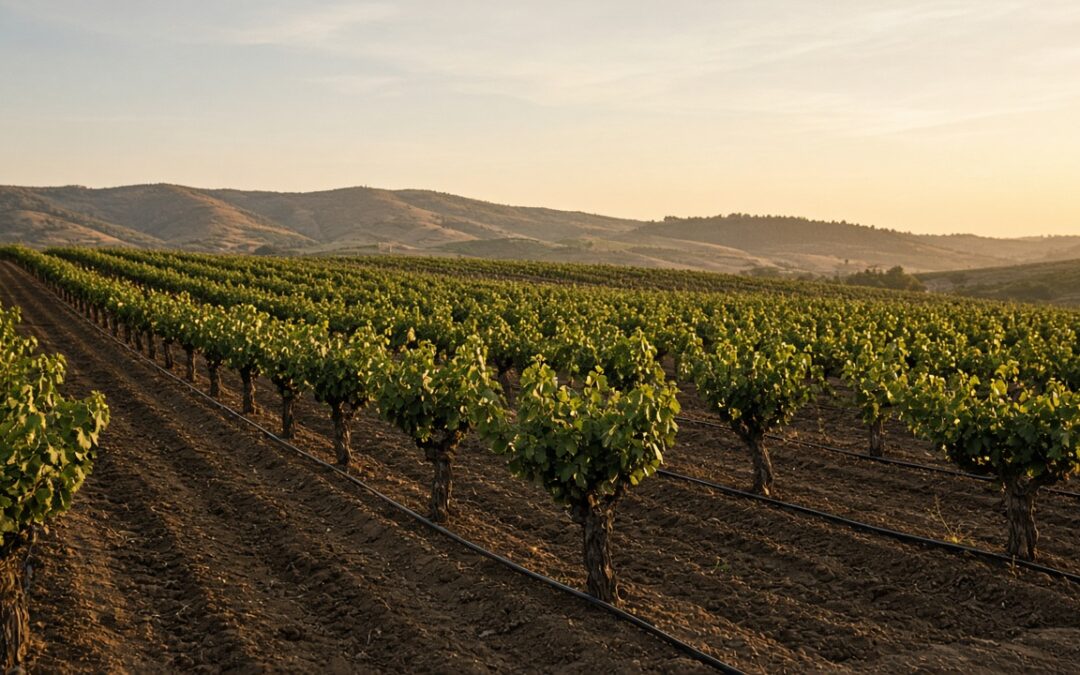
Vendor pages use “smart irrigation” for everything from a weather-linked sprinkler timer to a full farm dashboard. On a working farm, the phrase usually means something simpler and more expensive if you get it wrong: a system that helps you see whether the set reached the root zone, notice when the line is off, and act on a far valve without another drive—without handing agronomy to a black box.
A smart irrigation system in agriculture is a buying and operations category, not a crop method. Drip, micro-sprinkler, and solid-set still deliver the water. The “smart” layer is sensors, connectivity, a dashboard, alerts, and optional remote or threshold-based valve control. This post teaches that category: what belongs in the box, what stages make sense, what is farm vs greenhouse hype, and how to evaluate a vendor without buying fog.
If you already know you want the visibility-plus-control stack in field language, start with Remote Irrigation Monitoring and Control: What the System Actually Does. Here the job is the category definition and the buying checklist.
Quick Takeaways
- On farms, “smart irrigation” usually means soil and line visibility + alerts + optional remote valve action—not a greenhouse climate suite.
- Buy in stages: Monitor → Control → Automate only after thresholds earn trust.
- Extension-style irrigation scheduling still applies: measure soil water, match crop stage, do not water from habit alone.
- Evaluate openness (sensors you understand, thresholds you set, support that answers) over “set it and forget it” claims.
- AgriLynk does not replace the irrigator or farm manager.
What a smart irrigation system in agriculture actually includes
Strip the brochure language. A farm-ready smart irrigation system is a set of jobs:
| Component | Job on the farm | What “smart” does not mean |
|---|---|---|
| Soil sensors (often multi-depth; tension-based sensors show how hard plants work to pull water) | Tell whether the root zone needed the last set | Instant yield prediction |
| Line sensors (pressure; flow when instrumented) | Separate dry crop from clogged filter or closed valve | Fixing undersized pipe by itself |
| Field station + connectivity | Get readings off the block without Wi-Fi at every manifold | A radio seminar before you know the outcome |
| Dashboard + history | Compare this week to last week under similar weather | A second ERP for the whole farm |
| Alerts | Trip decision when a threshold you wrote down is crossed | A flood of ignored notifications |
| Remote valve control (optional) | Open/close or schedule a supported valve from the phone | Replacing laterals, emitters, or filters |
| Threshold automation (optional, later) | Start/stop inside watering windows from moisture targets you set | Agronomy decided by the vendor |
You can buy visibility without control. You should almost never buy automation before you trust the pattern on that block.
Farm system vs greenhouse (and other) hype
A lot of “smart irrigation” content is written for controlled environments: lighting, humidity, CO₂, fertigation recipes, and sealed greenhouse climate. Those tools can be excellent in a greenhouse. They are a poor template for an open orchard, vineyard, or drip block where the main pain is distance, soil variability, night sets, and quiet failures in pressure or wells.
When you evaluate a smart irrigation system in agriculture, ask which world the vendor is describing:
- Open-field / orchard / vineyard language — soil tension or moisture at depth, pressure, valve layout, cellular vs shared gateway, labor for the drive.
- Greenhouse / CEA language — climate loops, multi-factor recipes, indoor sensors as the center of the story.
- Municipal / landscape language — ET controllers and zone timers for turf. Useful for lawns; thin for commercial ag root zones.
If the demo never talks about a stuck solenoid, a filter flush, or a far block you cannot see from the shop, you may be shopping the wrong category.
The stage path: Monitor → Control → Automate
University and Cooperative Extension irrigation programs have said for years—UC ANR and similar extension irrigation-scheduling materials among them—that growers should schedule from soil water, crop stage, and weather, not from habit alone. Smart tools make that measurement usable between field walks. They do not cancel the scheduling idea.
A practical farm path:
- Monitor one priority block until soil and pressure patterns make sense. History beats a single midday reading.
- Control that supported valve from the dashboard when the reading says act—especially for night sets and distant manifolds.
- Automate only where the threshold has been stable enough that you trust it overnight, inside a watering window you define.
Skipping stages is how “smart” becomes an expensive surprise set. Remote manual control after visibility is usually the safer first win than full autonomy on day one.
For the stack detail (visibility half vs control half, cellular vs gateway), use the remote irrigation monitoring and control post. Keep this page as the category map.
How to evaluate a smart irrigation system without buying a black box
Use questions a farm manager can ask on a sales call:
- What do I see on day one? Multi-depth soil? Pressure? Flow? Alerts? History length?
- Who sets the thresholds? You—or a locked vendor model you cannot inspect?
- What valves and pumps does remote control actually support? “Works with everything” is not a field answer.
- Cellular one site or shared gateway many stations? Layout decides the connection model more than brand preference.
- What fails open vs fails quiet? If the station drops offline, who notices, and how?
- Who answers the phone when the first install is confusing? Support is part of whether the system stays in use.
- Can I start with Monitor and add Control later? Modular ownership beats a forced full-farm package.
Also walk the hardware you already have. A smart layer will not fix worn emitters, undersized mainline, or a filter that never gets flushed. Low irrigation pressure problems still need a pressure diagnosis—not only a new app.
What “smart” still leaves to the irrigator
A smart irrigation system in agriculture does not:
- Replace crop-stage judgment, stress targets, or a CCA where that role belongs.
- Decide fertigation or pest programs from a moisture graph alone.
- Work on unsupported valves without a field check.
- Invent cellular coverage where none exists.
Those limits are why honest quotes ask about valve type, spacing, coverage, and power—not only about “smart irrigation” as a buzzword. AgriLynk’s commercial path names the outcomes in the same order farms actually learn them: Monitor / Control / Autonomous / Enterprise. Live packaging and pricing on agrilynk.com win over any blog summary.
How AgriLynk Helps
AgriLynk builds practical remote farm monitoring and irrigation control around that same stage path: tension-based soil sensors, pressure, alerts, dashboard history, remote open/close and scheduling on supported valves, and optional threshold automation when you are ready. Systems are designed and assembled in Murrieta, CA. Support is a real person—phone, email, and chat—not a ticket maze.
For product and layout detail:
- Remote irrigation automation
- Irrigation visibility
- How it works
- 2026 pricing
- Contact AgriLynk — tell us what you need to monitor, control, or automate. Or call (760) 723-1529.
A smart irrigation system in agriculture earns the name when it makes the next set clearer—not when it hides the farm inside a slogan. Start with visibility you trust, add control when the drive stops making sense, and automate only after the thresholds earn it.