
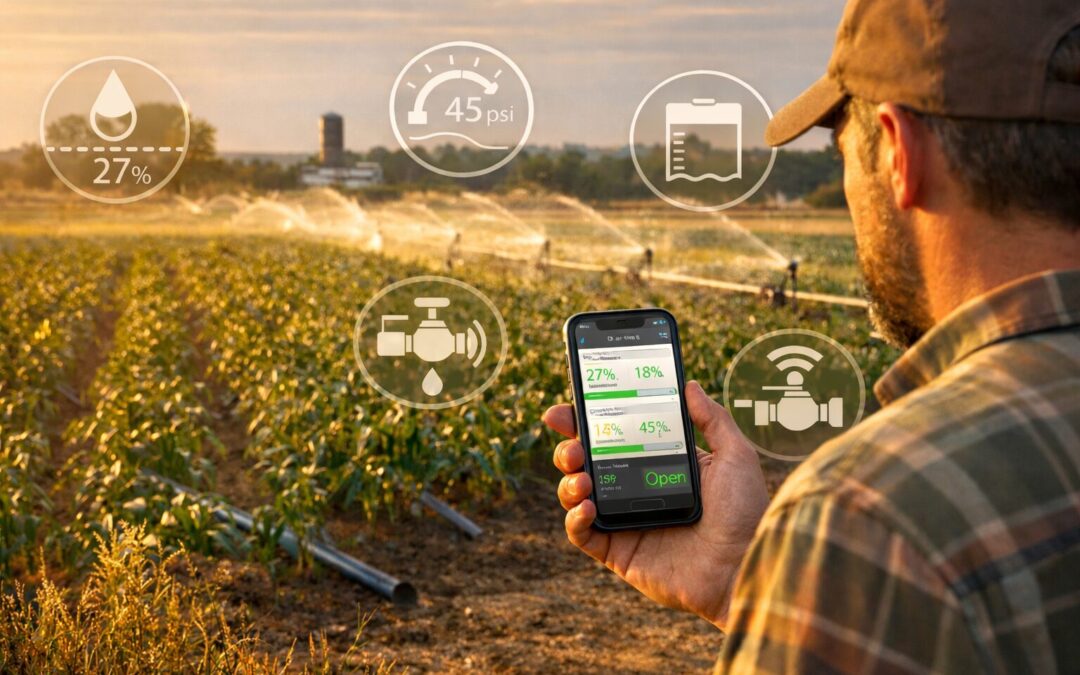
Farm infrastructure control gives growers something every operation needs more of: visibility. When you can see what is happening across your irrigation system, reservoirs, wells, pressure lines, and field conditions in real time, you can make better decisions before small issues turn into expensive problems.
For many farms, that is the difference between staying ahead and constantly reacting. A pump fault, a pressure drop, or an irrigation event that does not reach the full root zone can quietly reduce crop quality, waste water, increase labor, and cut into profit long before anyone notices it in the field.
That is where AgriLynk fits in. AgriLynk helps growers monitor and control critical farm systems with real-time data, remote access, and practical tools built for day-to-day farming. Instead of relying only on fixed schedules, manual checks, or guesswork, growers can use live field data to manage irrigation and infrastructure with more confidence.
In this guide, we will break down how infrastructure monitoring improves profitability, which systems matter most, and how AgriLynk helps growers turn field data into better outcomes.
Why infrastructure problems cost more than most farms realize
Most infrastructure-related losses do not show up as one obvious event. They build gradually through small inefficiencies that are easy to miss.
A field may be getting watered, but not deeply enough. Another may be getting too much water and pushing nutrients below the root zone. A pressure issue may reduce irrigation uniformity across a block. A reservoir may be dropping faster than expected. A well may not be recovering the way it should. None of those problems look dramatic at first, but together they can affect crop quality, timing, water use, labor, and revenue.
That is why infrastructure visibility matters. You cannot manage what you cannot measure.
When growers have real-time data, they can stop relying on assumptions and start making decisions based on what is actually happening in the soil and across the system.
The biggest opportunity is usually irrigation
For most growers, irrigation is where the fastest return shows up.
Water is expensive. Labor is expensive. Crop stress is expensive. And overwatering can be just as damaging as underwatering, especially in specialty crops where consistency, timing, and quality matter.
Many farms still irrigate based on habit, calendar schedules, or visual checks. That is understandable, but it leaves a lot of room for error. Conditions change fast based on weather, soil type, plant stage, and system performance.
AgriLynk helps growers move from schedule-based irrigation toward data-based irrigation.
Instead of asking, “Is it about time to irrigate?” the better question becomes, “What is the plant experiencing right now?”
That shift is where the value starts.
Why AgriLynk focuses on tension-based soil moisture monitoring
Not all soil moisture readings tell the same story.
AgriLynk is built around tension-based monitoring because tension shows how hard the plant has to work to pull water from the soil. That matters more than simply knowing whether water is present.
A soil can contain water and still make it difficult for the plant to access it. Soil texture changes everything. Sand, clay, and mixed soils all hold and release water differently. That is why a simple moisture percentage does not always tell the full story.
Tension-based monitoring gives growers a more practical view of plant stress and irrigation timing.
AgriLynk typically uses three soil sensors at different depths so growers can see what is happening through the root profile, not just at one point. That helps answer three critical questions:
1. When should irrigation start?
As tension rises in the upper root zone, growers can see when plants are beginning to work harder for water.
2. How long should irrigation run?
The middle sensor shows how water is moving through the active root zone.
3. When should irrigation stop?
The lower sensor helps growers avoid pushing water too deep past the target zone.
That three-depth view is one of the biggest advantages of the system. It helps growers understand not just whether they irrigated, but whether the irrigation actually did what they wanted it to do.
Better data leads to better irrigation decisions
The goal is not simply to use less water. The goal is to apply the right amount of water at the right time for the crop, soil, and growth stage.
Sometimes that means reducing irrigation. Sometimes it means applying more. What matters is accuracy.
With AgriLynk, growers can see how quickly soil dries down, how long it takes water to move through the profile, and whether irrigation is reaching the full root zone. That makes it easier to adjust schedules, respond to seasonal shifts, and avoid common problems like shallow watering, overwatering, or uneven crop performance.
For operations growing high-value crops, those improvements can have a direct effect on marketable yield and crop quality.
Pressure and flow monitoring catch problems early
Soil data is critical, but it is only one part of the picture.
A field can still underperform if the irrigation system itself is not operating correctly. That is why pressure and flow monitoring are such important parts of a complete AgriLynk setup.
Pressure monitoring helps growers confirm that a system is operating within the correct range. If pressure drops too low, emitters or sprinklers may not deliver water evenly. If pressure changes across the block, irrigation uniformity can suffer.
Flow monitoring helps detect issues such as leaks, broken lines, clogs, or unexpected changes in water use.
These are the kinds of problems that often go unnoticed until a crop shows stress or a water bill comes back higher than expected. Real-time alerts help growers respond earlier, before the issue becomes more expensive.
Reservoir and well monitoring protect water security
Water supply is too important to leave to occasional manual checks.
AgriLynk can monitor wells, reservoirs, tanks, and other water storage points so growers know what is happening in real time. That matters for both daily operations and long-term planning.
If a reservoir level drops unexpectedly, the system can send an alert. If a well is not performing normally, growers can see the change and investigate. If a storage tank is getting too low or too full, the system helps flag it before it becomes a bigger issue.
For farms managing multiple water sources, elevation changes, or complex irrigation zones, this kind of visibility can prevent costly disruptions and make the entire operation easier to manage.
Remote control reduces labor and improves response time
One of the strongest parts of the AgriLynk platform is that it is not just a monitoring system. It also supports remote control.
That matters because data is most valuable when it leads to action.
AgriLynk enables remote valve control, giving growers the ability to respond without having to drive out to every location. That saves labor, speeds up decision-making, and helps farms manage more efficiently across scattered fields or busy irrigation schedules.
In the right setup, AgriLynk can also support automatic irrigation behavior based on configured thresholds and schedules. That allows growers to build a smarter irrigation process that still reflects real field conditions.
The result is a better balance of automation and control.
AgriLynk is built for more than irrigation
Irrigation is often the first application, but AgriLynk is intentionally broader than that.
The platform can be used for a wide range of agricultural monitoring needs, including:
- soil moisture monitoring
- remote valve control
- well level monitoring
- reservoir level monitoring
- pressure monitoring
- flow monitoring
- temperature monitoring
- other specialized farm monitoring applications
That flexibility matters because no two farms are exactly alike. A grower may start with irrigation and later expand into water storage, equipment, temperature, or other infrastructure needs.
AgriLynk is designed to support that growth instead of forcing a one-size-fits-all approach. Internal sales guidance also positions AgriLynk first around irrigation while emphasizing its broader versatility for wells, reservoirs, pressure, flow, temperature, and specialized monitoring use cases.
Why this matters for labor, too
Water efficiency usually gets the headline, but labor savings are a major part of the value.
Without a monitoring platform, staff spend time driving, checking, probing, reporting, and troubleshooting. Some of that work is necessary, but a lot of it can be reduced when the farm has reliable real-time data available in one place.
AgriLynk helps reduce unnecessary field checks and makes the checks that remain more targeted. Instead of searching for problems, teams can respond to actual alerts and actual conditions.
That improves labor efficiency and helps managers spend more time making decisions and less time chasing information.
What makes AgriLynk different
AgriLynk is not trying to be technology for technology’s sake. It is built around practical farm use.
That shows up in a few important ways:
It is designed around how growers actually work
The system is meant to support day-to-day operations, not create more complexity.
It combines monitoring and control
Many systems can show data. Fewer help growers act on it remotely in a practical way.
It supports multiple use cases
AgriLynk can start with irrigation and expand into broader infrastructure monitoring as the operation grows.
It is accessible for real farms
AgriLynk’s internal sales process qualifies farms ready to purchase systems starting at $968, making the platform approachable for a wide range of operations rather than only large enterprise farms.
It is grounded in real agriculture
AgriLynk’s sales materials consistently center the product around real-time farm management, wireless data, and decisions that improve productivity and efficiency.
Who should be thinking about infrastructure control?
AgriLynk is especially useful for growers who are dealing with one or more of the following:
- rising water costs
- limited labor availability
- inconsistent irrigation performance
- high-value crops where quality matters
- multiple fields or zones to manage
- complex water infrastructure
- repeated issues with pumps, pressure, reservoirs, or timing
- a desire to automate without losing visibility
For these operations, better monitoring is not just about convenience. It is about protecting margin.
A smarter next step for modern farming
Growers do not need more noise. They need better information they can actually use.
That is what AgriLynk is built to provide: clear field data, practical alerts, and remote control tools that help farms respond faster and irrigate more accurately. Whether the goal is saving water, improving crop consistency, reducing labor, or getting better visibility into wells and reservoirs, the value starts with knowing what is happening in real time.
Farm infrastructure control is not just a technology upgrade. It is a smarter way to run a farm. With AgriLynk, growers can turn real-time monitoring into better irrigation decisions, stronger operational control, and more confidence across the systems that matter most. Contact us or call a real, live person in our Southern California facility at 760-723-1529