
Why Low Irrigation Pressure Matters
Quick Takeaways
- Low irrigation pressure is commonly caused by leaks, clogged filters, partially closed valves, pump issues, or excessive system demand.
- Looking at pressure and flow together often makes troubleshooting easier than relying on pressure alone.
- Continuous monitoring can help identify intermittent problems that may not appear during a manual inspection.
If sprinklers are not reaching their normal distance, irrigation is taking longer than expected, or pressure gauges suddenly look lower than normal, low irrigation pressure may be the cause.
The challenge is that pressure problems rarely point to one obvious issue. The same symptom can be caused by a leak, clogged filter, partially opened valve, pump issue, or change in system demand.
Finding the source of the problem requires looking beyond a single pressure reading and understanding how the entire irrigation system is performing.
Signs Your Irrigation Pressure May Be Too Low
In some cases, low irrigation pressure is easy to recognize. Sprinklers may not cover their normal area, emitters may deliver less water, or the far end of a block may receive less irrigation than the area closest to the pump.
Other signs can be less obvious. Irrigation may take longer than expected, crop response may become inconsistent, or one section of the operation may begin behaving differently from the rest.
Growers may also notice that a pressure gauge is reading lower than normal. While this is an important warning, the pressure reading alone may not explain what caused the change.
| If you notice… | It may indicate… |
|---|---|
| Low pressure with unusually high flow | Leak or broken irrigation line |
| Low pressure with reduced flow | Clogged filter, restriction, partially closed valve, or pump issue |
| Normal pressure near the pump but low pressure farther downstream | Restriction, leak, or valve issue between those locations |
| Pressure only drops during certain irrigation sets | Excess system demand or an intermittent issue |
These patterns are not a final diagnosis, but they can help narrow the investigation.
Common Causes of Low Irrigation Pressure
Several different problems can reduce pressure within an irrigation system.
A Leak or Damaged Irrigation Line
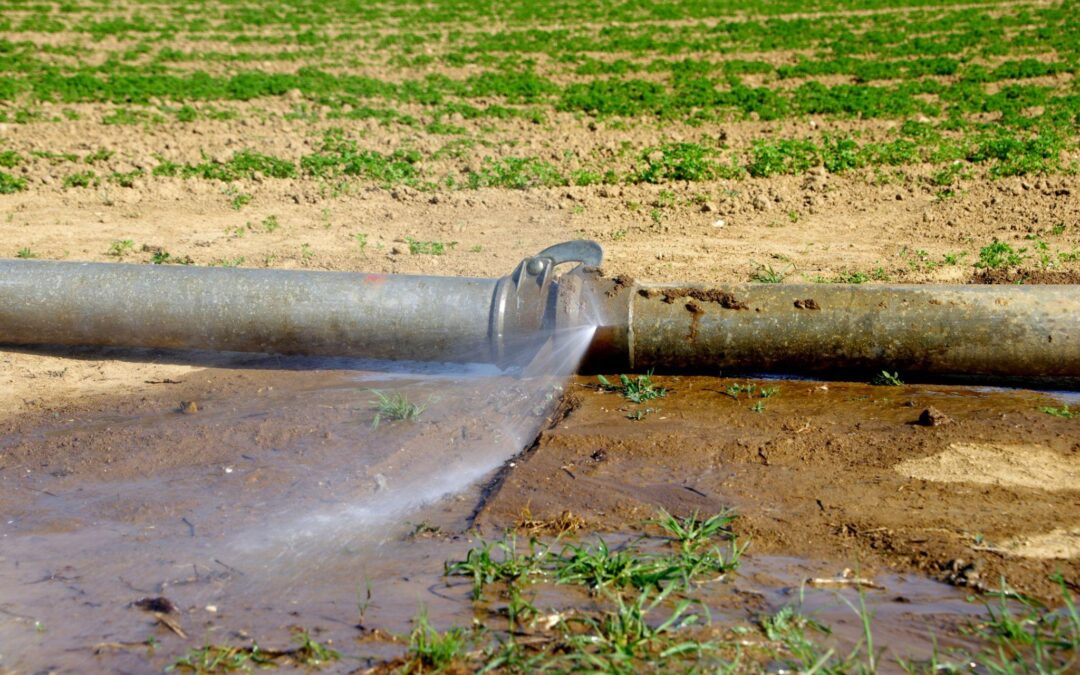
A broken pipe, loose connection, damaged fitting, or leaking valve can allow water to escape before it reaches the intended irrigation area.
Larger leaks may be visible, but smaller leaks can remain hidden underground or in areas that are not checked regularly. Even a relatively small leak can affect pressure and waste a significant amount of water over time.
A leak may also cause flow to increase while pressure decreases. Looking at both measurements can provide a clearer picture of what is happening.
A Clogged Filter
Filters are designed to protect irrigation equipment from debris, but pressure can drop when a filter becomes restricted.
If pressure is normal before the filter but lower after it, the filter may need to be cleaned or serviced. Regularly checking the pressure on both sides of a filter can help identify this problem before it affects irrigation performance across the field.
A Valve That Is Not Fully Open
Just because a valve appears to be open does not always mean it is allowing full flow.
Mechanical wear, debris, or internal damage can prevent a valve from opening completely, creating resistance within the irrigation system. That restriction can reduce downstream pressure and limit the amount of water reaching the field.
Pump Performance Problems
If the pump is not producing the pressure the irrigation system was designed for, irrigation performance throughout the field can suffer.
Pump performance may decline because of wear, electrical issues, suction problems, changing water levels, or operating conditions outside the pump’s intended range.
Because pump issues can be complex, growers may need to work with a qualified pump or irrigation professional to identify the underlying cause.
Too Much System Demand
Pressure may fall when too many irrigation zones, valves, or outlets are operating at the same time.
An irrigation system is usually designed around a specific flow rate and pressure range. Adding zones or changing how the system is operated can increase demand beyond what the pump and piping were designed to support.
If pressure returns to normal when fewer zones are running, system demand may be contributing to the problem.
Pipe Restrictions or Blockages
Mineral buildup, debris, root intrusion, collapsed pipe, and other restrictions can reduce the movement of water through an irrigation system.
These problems may develop gradually, making them difficult to notice. Pressure may slowly decline over time rather than dropping suddenly.
Comparing current performance with previous measurements can help reveal changes that might otherwise go unnoticed.
What Growers Should Check First
When low irrigation pressure appears, begin with the areas that can be inspected safely and easily.
Check visible pipes, fittings, valves, and connections for signs of leaking water. Inspect and clean filters according to the manufacturer’s instructions. Confirm that the correct valves are open and that the irrigation system is not operating more zones than intended.
It can also help to record pressure at several points in the system. A normal reading near the pump and a low reading farther downstream may indicate a restriction, leak, or valve issue between those locations.
If both pressure and flow information are available, compare them together. The relationship between the two measurements can help narrow the investigation and show whether the system may be leaking, restricted, overloaded, or experiencing a pump problem.
These patterns are not a final diagnosis, but they can provide a clearer starting point for inspection.
Why One Pressure Reading May Not Be Enough
A manual pressure check shows what the system is doing at one moment.
That can be useful, but many irrigation problems are intermittent. Pressure may drop only when a certain valve opens, when multiple zones run together, or when the pump has been operating for a specific amount of time.
Imagine pressure drops by 10 PSI during every irrigation cycle between 2:00 and 3:00 a.m. but returns to normal afterward. By the time someone checks the gauge later that morning, the system appears to be operating normally.
Without a record of what happened overnight, intermittent problems like this can be difficult to diagnose. Continuous monitoring helps capture these temporary changes so growers have a clearer picture of when the problem occurred and how long it lasted.
How Low Irrigation Pressure Affects the Field
Low irrigation pressure can affect more than the irrigation equipment itself.
When an irrigation system does not operate at the intended pressure, water may not be distributed evenly. Some areas may receive enough water while others receive less than expected.
This can create inconsistent soil conditions across a field. Growers may respond by irrigating longer, but extending the irrigation cycle does not always correct uneven distribution. It may instead apply too much water in areas that were already receiving adequate coverage.
Identifying the cause of the pressure problem is usually more effective than compensating for it with additional irrigation time.
Using Flow and Pressure Monitoring Together
Pressure shows the force moving water through the irrigation system. Flow shows how much water is moving.
Either measurement can provide useful information, but together they offer a much clearer picture of overall system performance.
A change in pressure can indicate that something has changed within the irrigation system. Comparing that change with flow can help determine whether the system may be leaking, restricted, overloaded, or performing differently than normal.
Instead of relying on memory or occasional gauge checks, growers can compare current irrigation cycles with previous ones. This makes it easier to identify unusual patterns earlier and investigate problems before they become more significant.
How AgriLynk Helps
AgriLynk helps growers monitor irrigation flow and pressure remotely as their irrigation system operates.
Instead of relying only on occasional gauge checks or physical inspections, growers can view how their irrigation system is performing over time through the AgriLynk dashboard.
By monitoring pressure and flow together, growers gain more than a single snapshot. They can see when pressure changed, how long the change lasted, and whether flow changed at the same time.
That additional context can help narrow the list of possible causes before someone heads into the field.
AgriLynk does not replace hands-on inspections or professional irrigation service. It provides growers with better information so they can investigate problems with a clearer understanding of how the irrigation system was performing when the issue occurred.
Better Visibility Can Shorten the Search
Finding the cause of an irrigation problem often involves eliminating possibilities one at a time. The more information a grower has, the easier it becomes to decide where to look first.
Low irrigation pressure can come from several different sources, and no single pressure reading can always explain the cause. By combining physical inspections with continuous flow and pressure information, growers can better understand what is happening within their irrigation system and respond before a small problem becomes a larger one.
Learn how AgriLynk flow and pressure monitoring can provide better visibility into your irrigation system.