
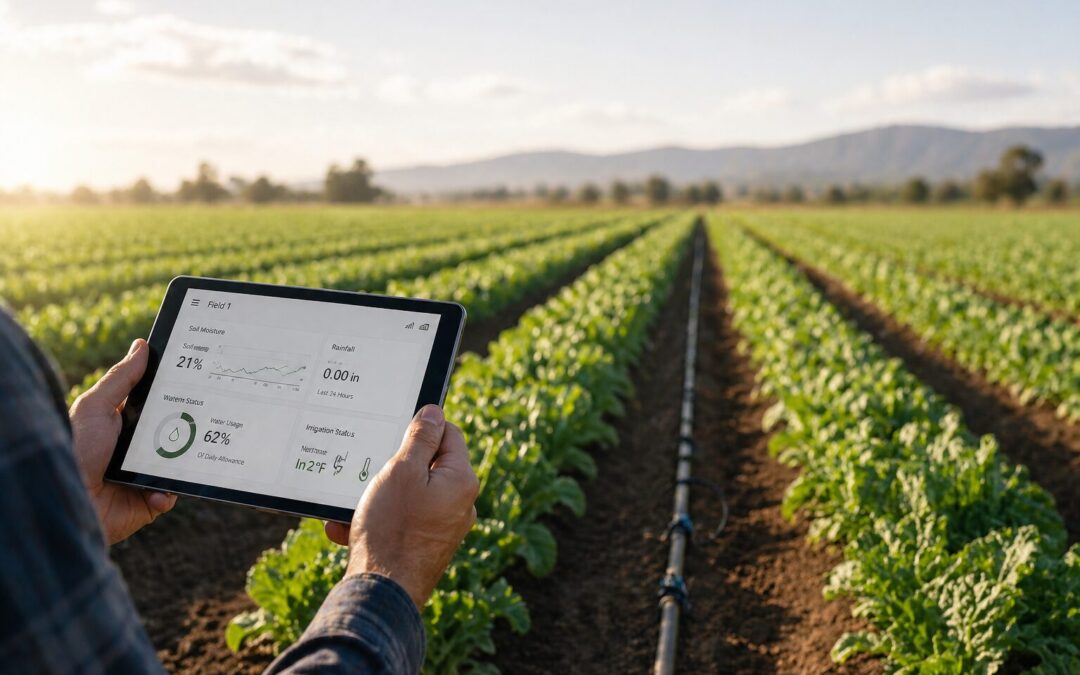
Even with soil sensors, weather data, and real-time dashboards, growers still make irrigation decisions the same way they always have.
Growers walk the field, remember how it looked last week, and rely on experience to know which areas dry out first. When uncertainty creeps in, it often feels safer to irrigate now rather than wait.
This isn’t a criticism. It’s reality.
There has never been more irrigation data available. However, access to data does not automatically improve irrigation data decision-making. Using data to change decisions requires something more.
There’s More Data Than Ever—So Why Isn’t Anything Changing?
Modern farms now use tools that didn’t exist even a decade ago. Soil moisture sensors reveal what’s happening below the surface, while weather feeds provide constant updates. In addition, flow and pressure data help growers understand system performance in real time.
Despite this, many operations still rely on routines and experience when making irrigation decisions.
For example, a sensor might show that moisture still exists deeper in the root zone. However, if the routine calls for irrigation every few days, the system still runs. Likewise, a dashboard might show that one block dries faster than another, but both blocks often receive the same treatment due to labor or scheduling constraints.
In other words, the data exists, but it does not change behavior.
The Gap Between Information and Action
The real challenge is not access to information. Instead, the challenge lies in what happens after growers receive that information.
Years, often decades, of experience shape irrigation decisions. That experience matters because it protects crops and builds confidence in uncertain conditions. As a result, new data must compete with long-standing habits.
Naturally, growers ask important questions. Can they trust the sensor? What if the reading is wrong? What happens if waiting reduces yield? What if a new decision leads to regret?
When those questions remain unresolved, most growers return to familiar practices. Consequently, irrigation data gets observed, but irrigation data decision-making does not improve.
Why Visibility Alone Isn’t Enough
Seeing soil conditions provides value, but visibility alone does not improve outcomes. What actually matters is how data influences timing, duration, and confidence. When growers trust the data, they begin to make small but meaningful changes.
For instance, they may wait an extra day because deeper moisture remains available. In other cases, they shorten irrigation cycles because the target depth has already been reached. They may also treat blocks differently instead of applying a uniform schedule.
These changes may seem minor. However, over time, they lead to better irrigation data decision-making, improved water efficiency, and healthier crops.
A Better Question to Ask
Many operations ask whether they have soil moisture sensors or irrigation monitoring tools in place.
However, a more useful question focuses on outcomes. Has irrigation data decision-making actually improved since those tools were installed?
If the answer is no, then the operation likely has untapped potential. Sensors are not the goal. Dashboards are not the goal. Better decisions are the goal.
How AgriLynk Improves Irrigation Data Decision Making
AgriLynk focuses on one core idea: data only matters when it leads to action.
Instead of simply collecting information, AgriLynk helps growers understand what is happening across the root zone and respond in real time. The system measures soil moisture in a way that reflects what the plant actually experiences. As a result, growers trust the data more easily. That trust drives better irrigation data decision-making.
When growers clearly see how water moves through the soil and how crops respond, they adjust irrigation timing with confidence. For example, they may reduce unnecessary irrigation cycles or respond faster when conditions change. They can also manage different blocks based on actual field conditions instead of relying on a fixed schedule.
In addition, AgriLynk connects monitoring directly to control. This connection allows growers to move beyond observation and take immediate action. Ultimately, growers gain more than data; they gain control over how water is used across the farm.
Why This Matters
Water, labor, and time remain some of the most valuable resources in agriculture. When irrigation decisions do not evolve, operations often use these resources inefficiently. On the other hand, strong irrigation data decision-making leads to better outcomes.
Growers apply water more precisely. Crops experience less stress. Teams operate more efficiently. Over time, these improvements create more consistent and predictable results.
Final Thought
Technology does not improve operations simply because it gets installed. Instead, it improves operations when people trust it enough to change how they act.
The farms that benefit most from irrigation data do not necessarily have the most sensors. Rather, they consistently use data to improve irrigation data decision-making.