
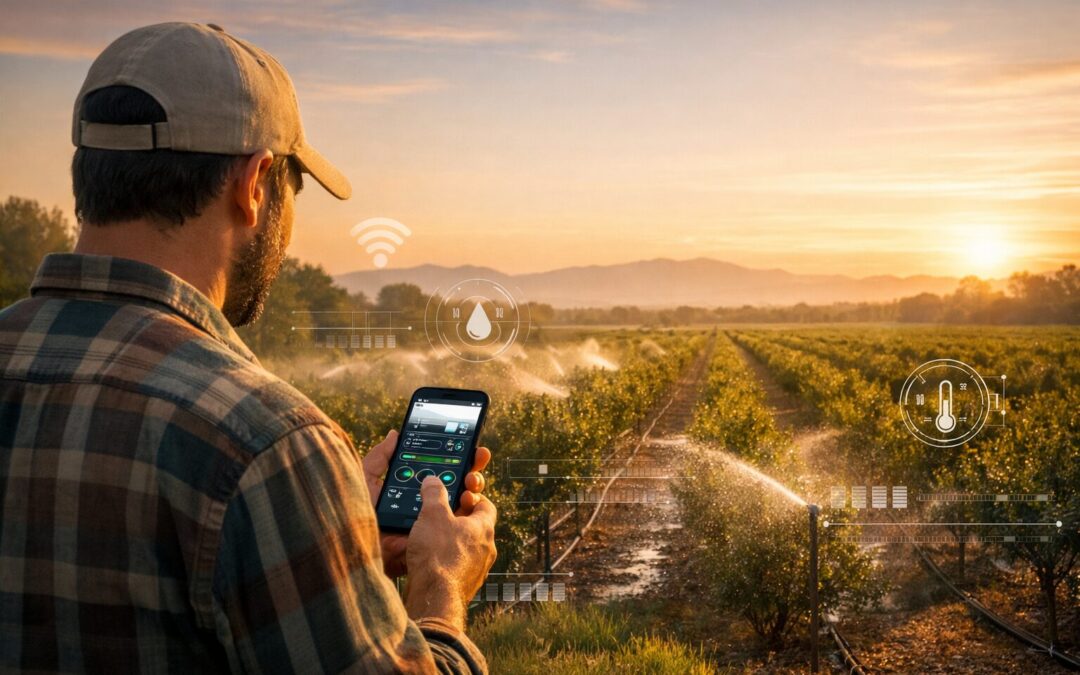
If you’ve ever looked at an irrigation bill and thought, “We’re doing everything right… so why is this still so expensive?” you’re not crazy. On most irrigated farms, the biggest money leaks are not dramatic. They are quiet, repeatable, and easy to miss. The good news: remote farm control is one of the fastest ways to plug those leaks by cutting unnecessary pump-hours, reducing wasted irrigations, and helping you catch problems early, without adding more daily field drives.
To keep this real, a lot of ag-tech blogs lean on “customer stories” that are basically fiction. Instead of a made-up hero case study, this article uses a composite scenario based on the patterns we see across irrigated permanent crops like citrus, nuts, avocados, vineyards, and similar operations.
The quiet ways farms lose money on irrigation
Most farms are not “doing it wrong.” They are managing irrigation with the tools they have: timers, experience, and manual checks. The problem is that irrigation systems can look fine while quietly wasting money.
Here are the three most common drains.
1) Water and pumping waste from irrigating without root-zone visibility
Timers do not know if yesterday’s set reached the root zone, or if it pushed past it.
Without soil data at the right depths, farms tend to:
-
Water longer than needed “just to be safe”
-
Water again too soon because the surface dries quickly
-
Manage to the “average” and miss variability between blocks
Even modest improvements in scheduling can translate to fewer pump-hours and fewer unnecessary sets over a season.
2) Labor and windshield time that does not scale
A lot of irrigation “management” is really checking:
-
Driving out to see if a set finished
-
Manually opening and closing valves
-
Looking for leaks after the fact
-
Checking pressure, filters, tanks, and asking “is it running?”
That time adds up fast, especially when you’re juggling multiple blocks, remote sites, or a lean team.
3) Problems you discover late (the expensive part is the delay)
The biggest hits often come from when you find the issue, not the issue itself:
-
A valve stuck open for hours
-
A pressure problem that under-applies a whole set
-
A pump issue that shows up over a weekend
-
A slow leak you don’t notice until you see a wet spot, or a bill
Catching issues earlier is how you avoid the “it ran wrong all night” moments.
The simple framework that makes smart farm tech pay off
Smart farm tech gets complicated quickly. The version that consistently delivers ROI follows a simple loop:
-
Measure what’s happening in the root zone
-
Verify the system is behaving normally
-
Control and respond without driving
Let’s break that down.
Measure what plants can actually use (in the root zone)
Soil moisture should answer practical questions like:
-
Did the irrigation reach the active root zone?
-
How fast is the block drying down?
-
Are we pushing water past where roots can use it?
At AgriLynk, we’re big fans of tension-based soil moisture sensors (Watermark) because they’re practical and consistent across soil types. Instead of only reporting “water content,” tension reflects how hard plants have to work to pull water, which makes it easier to interpret across sand, loam, and heavier ground.
Most growers get the best insight from multiple depths. Depths vary by crop and rooting, but the goal is the same: see the full profile, not just what’s happening at the surface.
Verify the system is doing what you think it’s doing
Soil moisture gives you plant-side reality. You also want system-side reality so you are not guessing.
Useful signals include:
-
Pressure (is the system operating normally?)
-
Flow (where applicable, it helps spot leaks, stuck valves, and odd behavior)
-
Rainfall and temperature (optional context that improves decisions)
A lot of “we watered” problems are actually “we thought we watered.”
Control and respond without rolling a truck
Monitoring is valuable. Control is where the savings accelerate.
When you can adjust irrigation without driving, you reduce:
-
Response delays
-
Labor time
-
Crop stress windows caused by late fixes
This is where true two-way capability matters. One-way monitoring tells you something is wrong. Control lets you do something about it right now.
The buyer’s checklist: what actually matters (and what does not)
If you’re evaluating systems, here’s the no-fluff list.
Multi-depth insight (not just one sensor)
One depth can mislead you. Multi-depth shows:
-
Whether irrigation reached the root zone
-
Whether you are overshooting and wasting pump-hours
-
How different blocks behave under the same schedule
Monitoring plus action
If a system only graphs data, you still end up driving to fix things.
Look for:
-
Remote valve control
-
Scheduling changes from anywhere
-
Alerts that actually help you act, not just watch
This is one of the places remote farm control separates itself from “monitoring only” tools.
Connectivity that fits real farms
Many farms do not have Wi-Fi across every block. Cellular-based gateways are often the practical answer when you are beyond the shop yard or dealing with remote sites.
Alerts you can tune (so you do not ignore them)
Alerts should be:
-
Configurable to your crop stage and your operation
-
Delivered by SMS and email
-
Shared with a backup person when needed
If everything is urgent, nothing is.
How to start (without turning this into a giant project)
The farms that win with this tech do not start by monitoring everything. They start with the place that hurts.
The best first install is usually one of these:
-
Your highest-value block
-
Your “problem” block (variability, stress history, tricky sets)
-
A critical pump or pressure point where failures ripple outward
Run it for a few weeks, learn what “normal” looks like, then tighten schedules and thresholds.
Expect a short learning curve, and treat it like a win
Most growers spend the first 2 to 4 weeks dialing in:
-
Alert thresholds
-
Irrigation durations
-
Block-specific drydown patterns at different depths
That is not setup pain. That is learning what your farm is actually doing. Once you have that baseline, decisions get faster and cleaner.
Where AgriLynk fits (practical, scalable, built for real operations)
AgriLynk is built for growers who want the benefits of modern monitoring and control without turning the farm into an IT project.
What that looks like in practice:
-
Real-time monitoring in a single dashboard
-
SMS and email alerts that can be tuned to your operation
-
A system you can start small with (one block or one station) and expand as it proves ROI
The goal is not to overwhelm you with data. It is to help you:
-
See root-zone reality
-
Verify system performance
-
Respond quickly when something shifts
Quick ROI reality check (simple and conservative)
You do not need perfect math to know if this is worth it. Use a conservative estimate and start with your biggest lever.
Step 1: Pick your main lever
Choose one:
-
Pumping and energy costs
-
Water costs
-
Labor time spent checking and managing irrigation
-
Risk cost (how much a “bad weekend” could hurt)
Step 2: Estimate a modest improvement
Avoid optimistic assumptions. Think:
-
Fewer unnecessary irrigations
-
Slightly shorter run times in some blocks
-
A few hours per week reclaimed
-
Avoiding one meaningful incident per season
Step 3: Compare against a starter deployment
Scope a starter system around one high-impact block or station. If the savings are even close, it is worth starting, because visibility tends to reveal additional opportunities after the first month.
FAQ
Q: What’s the fastest way smart farm tech saves money?
A: Reducing unnecessary irrigations and pump-hours by showing what’s happening in the root zone, and helping you catch problems early.
Q: Do I need automation to get ROI?
A: Not always. Monitoring plus alerts can deliver value on their own. But remote control usually accelerates ROI by cutting drive time and response delays.
Q: Why multi-depth soil moisture?
A: Because one depth can lie. Multi-depth shows whether water reached the root zone and whether you’re pushing past it (waste).
Q: Can I start small?
A: Yes. Starting with one block or one station is often the best approach: prove it, then scale.
Want an ROI estimate mapped to your farm?
If you tell us:
-
Crop type and acres in the target block
-
Irrigation method (drip, micro, or sprinkler)
-
Water source (district or well) and typical set durations
-
Your number one pain point (waste, labor, or risk)
We’ll map a practical starter setup and a conservative ROI estimate. That is the real value of remote farm control: making irrigation decisions based on what’s actually happening, then letting you act fast without extra trips to the field. Click here to get started.