
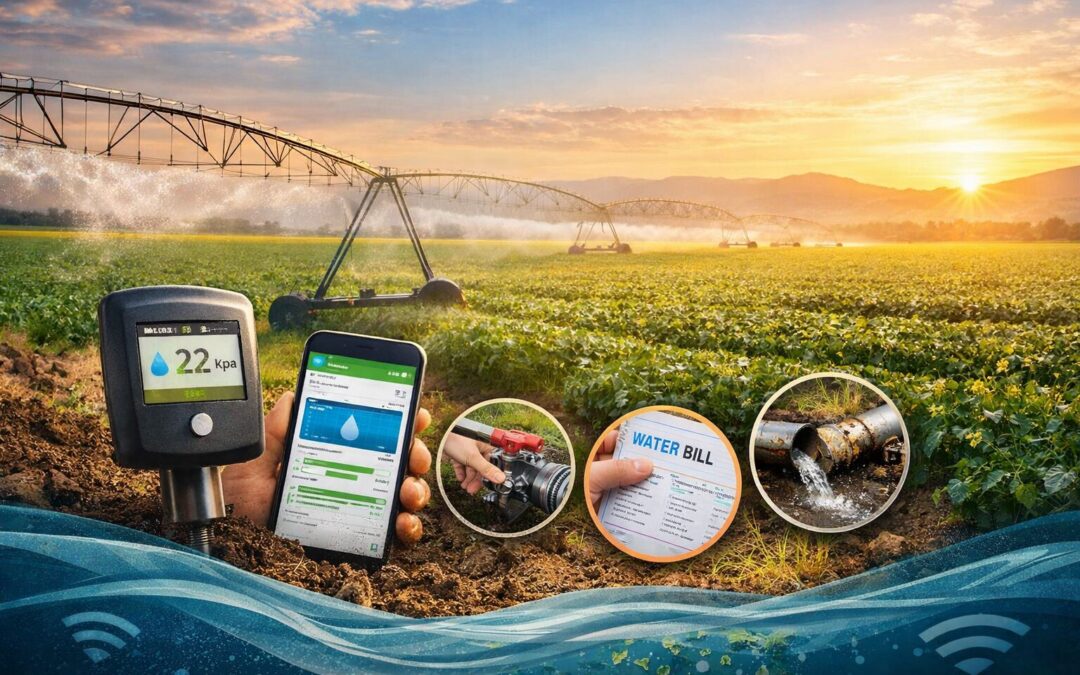
Water management can make or break a season. When irrigation decisions are based on guesswork, fixed schedules, or manual checks, farms often end up wasting water, losing time, and missing yield potential. Smart water management for farms helps growers replace guesswork with real-time visibility. Instead of wondering whether fields are too dry, too wet, or running into system problems, you can see what is happening and act faster. Whether you manage specialty crops, row crops, orchards, vineyards, or livestock infrastructure, the same pattern shows up again and again: farms that can measure water more accurately make better decisions.
Here are five signs it may be time to upgrade to a smarter approach.
1. You are irrigating on a timer instead of actual field conditions
Many farms still irrigate on a fixed schedule. Maybe a field gets watered every Tuesday and Friday, or a valve runs for a set number of hours each week. The problem is that fields do not behave the same way every day. Rainfall, temperature, wind, crop stage, soil type, and root depth all change how much water a crop actually needs. When irrigation is based only on time, it often leads to one of two outcomes:
-
Overwatering that wastes water and energy
-
Underwatering that stresses plants and reduces performance
Smart water management for farms changes this by using real field data instead of assumptions. Soil moisture monitoring helps you understand what is happening in the root zone so irrigation can be based on crop need, not just the calendar. At AgriLynk, this is where tension-based soil moisture monitoring becomes especially useful. Rather than only showing whether water is present, tension sensors help show how available that water is to the plant, giving growers a more practical picture of irrigation timing.
2. You or your crew spend too much time checking irrigation systems manually
If someone is regularly driving out to inspect pumps, valves, tanks, or field conditions, that labor adds up fast. Manual checks also create blind spots. A system may look fine in the morning, then develop a leak, pressure issue, or valve failure a few hours later. By the time someone finds it, water has already been lost and crops may already be affected. This is one of the clearest signs a farm needs smart water management.
With remote monitoring, growers can view key information from a phone or computer, including:
-
Soil moisture trends
-
Pressure changes
-
Flow activity
-
Pump runtime
-
Tank, reservoir, or well levels
Instead of spending valuable hours checking whether irrigation happened, you can verify system performance in real time and respond faster when something changes.
3. Your water bills keep rising, but your results are not improving
Higher water use does not automatically mean better crop performance. In many cases, rising water costs without stronger yields point to inefficient irrigation. Water may be moving past the root zone, nutrients may be leaching away, or plants may be cycling between too wet and too dry.
That creates a costly chain reaction:
-
More water use
-
Higher pumping or utility costs
-
More fertilizer loss
-
More plant stress
-
More labor spent correcting avoidable issues
Smart water management for farms helps break that cycle. When growers can see moisture conditions and irrigation performance in real time, they can apply water more precisely and avoid unnecessary waste. AgriLynk customers often use this kind of visibility to improve irrigation timing, reduce unnecessary watering, and make more confident decisions across the season. AgriLynk’s platform was built on a 700-field flower farm in Southern California, where real-world irrigation complexity drove the need for better control and monitoring.
4. You are managing multiple soil types or fields the same way
Very few farms are truly uniform. One field may have sandy soil that drains quickly. Another may hold water much longer. A low area may stay wet while a hillside dries out early. Even within one ranch, irrigation needs can vary a lot. When all fields are treated the same, water management becomes inefficient by default. Some zones get too much water. Others do not get enough.
Smart water management for farms helps growers manage field variability with better information. By monitoring representative zones and adjusting irrigation accordingly, farms can stop treating every field like it behaves the same way. This matters even more for operations managing multiple properties, remote blocks, or different crop types. Better zoning and better data lead to better water use and more consistent performance.
5. You have had expensive surprises like dry tanks, flooded areas, or pump issues
A lot of costly farm problems are not caused by a lack of effort. They happen because nobody knew there was a problem until it became urgent.
Examples include:
-
A pump fault that stops water delivery
-
A tank level that drops too low
-
A valve that fails open
-
A pressure issue that signals a leak or blockage
-
A field that gets too dry over a weekend
-
A livestock water source that is not refilling properly
These are exactly the kinds of problems smart monitoring is meant to catch early.
AgriLynk was built to help farms monitor not only irrigation, but also broader infrastructure such as wells, reservoirs, stock tanks, pressure, flow, and temperature-based systems. The sales brochure describes AgriLynk as a wireless, real-time farm management platform designed to improve productivity and efficiency with actionable data. When farms get alerts quickly, they can act before a small issue becomes a major loss.
What smart water management looks like in practice
Smart water management for farms is not about adding complexity for the sake of technology. It is about making irrigation and water-related decisions easier, faster, and more accurate.
A practical system should help growers:
-
Monitor soil moisture in the root zone
-
See irrigation performance remotely
-
Catch system failures early
-
Reduce unnecessary field checks
-
Manage different fields based on actual conditions
-
Make better use of labor and water resources
AgriLynk is designed around those real farm needs. The platform focuses heavily on irrigation, including moisture sensing, remote valve control, and water efficiency, while also supporting broader monitoring needs like well levels, reservoir levels, pressure, flow, and other farm infrastructure.
For growers looking to start small, AgriLynk’s pricing materials show entry-level hardware starting below $1,000, with subscription options available based on system needs.
Why this matters now
Water is one of the most important and expensive resources on the farm. At the same time, labor is tight, input costs are high, and growers need better visibility to stay efficient.
That is why more farms are moving toward smart water management.
The goal is simple: measure what matters, respond sooner, and make better decisions with less guesswork.
If your operation is still relying on timers, field-by-field manual checks, or best guesses about root-zone conditions, these five signs are worth paying attention to.
How AgriLynk helps farms manage water more intelligently
AgriLynk helps growers move from reactive irrigation management to proactive decision-making.
With AgriLynk, farms can:
-
Monitor soil moisture in real time
-
Check irrigation system status remotely
-
Receive alerts when something changes
-
Improve water efficiency
-
Reduce unnecessary labor
-
Manage irrigation with more confidence across multiple fields
For farms that want smarter control without overcomplicating daily operations, that kind of visibility can make a major difference.
FAQs
What is smart water management for farms?
Smart water management for farms is the use of real-time monitoring, alerts, and control tools to help growers irrigate more accurately, reduce waste, and respond faster to problems.
How do I know if my farm needs smarter irrigation tools?
Common signs include irrigating on fixed timers, spending too much labor checking systems manually, rising water costs, inconsistent field performance, and costly surprises like pump failures or empty tanks.
Can smart water management help smaller farms?
Yes. Smart water management is not only for large operations. Smaller farms can also benefit from better visibility into soil moisture, irrigation timing, and infrastructure performance.
Final takeaway
If your farm is dealing with inconsistent irrigation, rising water costs, or too much time spent checking systems manually, it may be time to adopt smart water management for farms.
The biggest shift is not just automation. It is visibility.
When you can see what is happening in your soil, your irrigation system, and your water infrastructure, you can make better decisions, protect your resources, and run a more efficient operation.
Contact Us today to speak with a member of our Southern California-based team.